

This is a recap of a twenty-five-night cruise from Bali to Tahiti onboard the Oceania cruise ship Regatta. The South Pacific is a unique world that has developed, and which moves in a rhythm alien to most of the world. Its cultures and histories are different and yet recognizable as there are stories and legends of people’s taking not to an empty continent, but rather to a huge ocean in search of a better life. I hope you will enjoy the commentary.
Bali: After a fifteen-hour flight from Los Angeles to Hong Kong, we had a three-hour layover and then a five-hour flight to Bali.
One of the 7,000 or so islands that makes up the nation of Indonesia, this beautiful island is inhabited by some of the most kind and gentle people in the world. Over seventy percent of the inhabitants are employed in the hospitality industry, and they seem to have developed it into a fine art. Although the economy suffered during Covid (as the locals say, “The lights went out”, They are smiling and courteous which immediately puts one at ease, as you feel the realities of the outside world fall away from you. I believe the secret of their lives is their faith. Seventy-five percent of the residents are Hindu and on a single day of touring, we passed by dozens of active temples, where small offerings of fruit or flowers are laid on the entry steps. These represent thanks for each person’s favors received on that day and it is not unusual during a talk with a local to be advised that we all need to accept the good with the bad, that we need to be sure to do good so that we will receive good. It really is charming and nice to see such a positive, active everyday bit of religion. We hear about the very politically active Hindu of P.M. Modi, but that is not how it is practiced in Bali.
Although we only had a couple of days in Bali before our cruise, we were fortunate to hire a gentleman by the name of Manuaba with whom we spent the better part of one day plus rides to and from the port. He is from the Brahmin class and aside from being a great driver (traffic in Bali can be quite interesting!), he showed us much more of Bali and its’ culture than expected. If you go to Bali and would like his number, please let me know. I believe you will be pleased.
We visited a number of interesting sites on the island, including a monkey sanctuary where the locals and visitors can be immersed in a jungle environment and where the monkeys roam freely. Although they are wild, they are used to humans and the local ground keepers make sure that the humans can enjoy the monkeys while still realizing they are wild animals. Be careful with your hats, sunglasses or water bottles are the monkeys seem to enjoy grabbing them and scurrying up the trees as the items former owners wonder what happened! We also visited a shop making Batik which is a printing process on cloth using hot wax for the pattern. This is an art form that is passed down from generation to generation and the patterns can be used for clothing or wall hanging as photos
Another interesting site we visited included a local coffee plantation where we were served a dozen different coffees to sample, such as Lemon Grass and Turmeric. Of course, we were happy to purchase several flavors for enjoyment back home. There are also woodworking shops to visit, and Batik shops, which are local fabric producers where generations of artists create wonderful shirts, skirts, and pictures which you will not find anywhere else in the world.
One thing that stands out and makes Bali so popular is the low cost of living well. The local incomes are low (a teacher makes about $300 a month!) and somehow despite the large number of tourists, prices are very reasonable. I asked Manuaba if he takes “vacations” and he said no as the economy does not allow most of the population enough to take a trip. In fact, the cost of one of us on the cruise would be enough to support a family of four for a year. Another example is realize what you have and be thankful. I should have put an offering at a temple for that bit of information. Even at an excellent hotel like the Sheraton in Kuta, the prices are very reasonable, and you can have a meal with drinks for under twenty dollars. This attracts visitors from around the world but if you go, be one of the “good” visitors. This is not the case in Tahiti. Fortunately, the best visitors (as per the locals) seem to be Europeans and Americans as those two groups are courteous and respectful.
I recommend hiring a driver as the streets are crowded with motor scooters and cars and the traffic is even more crazy than Cairo! Our driver is a real pro and you will be in the best of hands!
Darwin Australia: Located on the northern shore of Australia, Darwin is a very nice city of about 240,000. As soon as we got off the ship, I felt a “On the Beach” vibe; you feel you are at the end of the world. I believe it is due in part to the fact that although the city is built on the shores of the Pacific, you cannot go swimming in the waters, unless you want to be eaten by the local crocodiles or stung to death by the box jelly fish which native to the area. The crocodiles were almost exterminated during the 50s-60s and were named a protected species but now the local government looks like it is going to cull the herd as the rivers and shores are simply too dangerous. If you want to go swimming, the city has reclaimed some land and made them into protected beaches. Another isolating factor is as you approach Darwin, on either side of the port for as far as you can see, the norther shore of Australia runs to the horizon with nothing to show any impact by humanity.
Darwin has a very interesting history centered on two major events: the city was bombed by the Japanese over sixty times early in World War I which caused hundreds of deaths and major destruction, and cyclone Tracey destroyed 92% of all the buildings in the city. Since then, a new city has arisen which has already withstood the challenge of another even larger cyclone.
June is an ideal month to visit as the temperatures are mild (about 65 degrees) and the humidity is low. In fact, the locals can be seen wearing jackets during the early AM as they feel the temperature is cool. This is because during the three wet months, they receive about a foot of rain a month and the temperatures are in the mid to high 80s, leading to a lot of humidity. Ideal weather for the crocs, but as a cabby said, “after 15 years, I am still not acclimated to the weather”.
The next stop was to be Thursday Island but as we entered the harbor, we were advised that the visit was cancelled due to an approaching weather front. Every island has large signs with a warning scale regarding cyclones which can suddenly appear and sweep across the islands causing massive damage. In cities like Darwin where modern building codes have been followed, the damage is often limited to some trees knocked down, but on the smaller islands, even the smallest squall can disrupt everyday life. It turned out that we were able to outrun the cyclone which created waves two meters higher and had strong winds. Fortunately, there was no loss of human life.
Cairnes Australia: Cairnes is a beautiful city of about 150,000. A clean, well-kept city, it is a popular vacation destination for Australians and the people are friendly. We enjoyed the Cairnes museum which followed the exploration and development of the city as well as the interaction with the natives. Both the settlers and the natives were capable of violence against the other and eventually the natives were placed on reservations, the argument being that they were protected but in reality, they were placed under a controlled environment.
While the current city is beautiful, the story of how the settlers managed to wrestle with the local jungle is quite amazing. One example is that longshore men had to carry one-hundred-fifty-pound bags of sugar on the docks. The sugar is not like your table sugar; it is like hauling rocks and it tore at the backs of the dock workers causing cutting and bruising. A crew had to load twenty-four tons of sugar in a single shift and with the heat and humidity, the men were always in danger of de-hydration, subject to the mosquitos and the lack of water. Pioneers, the men and women lived and created a prosperous, clean island of civilization on an island that was harsh and unforgiving.
Townsville, Australia: Another small city where at least one could swim along most of the coast. We took a local ferry for about a hold hour to Magnetic Island which offers a bit more rustic view of local life. While all of the amenities of modern life are on the island, one feels it is just a step away from today’s world. The houses are not as sturdy, there are many camping sites and hiking trails that you find via paths (often ill-defined) in the local jungle, and one goes from one end of the island to the other in about twenty minutes and has the same bus driver on the ride back. Definitely a place to go if one wants to look for a very different style of life.
Cruising: due to an earthquake at Port Vila, Vanuatu, the stop at the port was cancelled. The earthquake was so severe that the docks were destroyed, and ships could not load or unload until repairs were completed. It is a reminder that those beautiful islands are out I the Pacific with little room for errors in everyday life.
Change of Plans: As the cruise was in the Southern Hemisphere, we were in the winter season. This meant that there were numerous storms, some of cyclone strength in the area. One port was cancelled due to an earthquake which destroyed the port facilities. The entire area is in the Ring of Fire, created by extinct and active volcanoes, so one has to be flexible on a cruise in the South Pacific. In fact, we had several days of overcast weather although we missed the rain and high winds that can be quite an experience. In the end, we had a couple of extra “sea days” which is an excellent excuse to get a bit more reading, work on that big puzzle or just enjoy the time to do little.
Handy Tip: At each stop, the cruise ship company offers various package tours which are created to fit the schedule of the ship. They can be pricey, but they are easy to handle and you don’t have to do anything except follow the directions of each tour director. An option is to leave the ship and talk to both the local tour companies and the taxi drivers who are waiting at the doc. They will explain their options; you can tell them where you want to go based on the information you received from the cruise line and then haggle for a price. If you know the tour price from the ship, you can start to work down from there. It is a good way to save 50% or more, but many drivers only accept cash (in the local currency) so know your exchange rates. Another thing is to make sure the driver knows what time the ship leaves port as there is nothing so forlorn looking as a cruise passenger waving goodbye to the ship that they missed!
Mystery Island, Vanuatu: A small island which you can easily walk around in a couple of hours. It has no electricity, no running water, in fact, it is as nature planned it except for an old air base from the Second World War which drove the Japanese crazy as they could not figure where the American planes which bombed them came from. The one special thing is that it has a beach; believe it or not, not all islands have beaches; instead, the foliage grows right down to the water.
Lautoka, Fiji: A true look at island life; known as the “Sugar Island”, it is the second largest city in Fiji. It has a true rustic, almost frontier feel to it. There is little to see in the city center aside from dozens of shops selling cell phones and sim cards but there were a couple of local tours to the surrounding hillsides.
Suva, Fiji: Suva is the largest city and is more cosmopolitan than Lautoka. There are numbers of tours to the local forests, hiking opportunities, tours to a waterfall, etc. These activities normally run $150-250/person. By this time, one more forest is a bit like one more cathedral in Italy, but we managed a tour to a local beach resort where we were treated to a one-hour native dance troupe made up of college students who perform to supplement their income. They were excellent and their dancing had delicate movements, fierce warrior dancing and a beautiful farewell song. It was definitely the highlight of the Fiji visit.
Point of Information: Watch your itinerary as on many islands, everything is closed on Sundays. Well, not everything, as the churches are open and well attended while the rest of the day is focused on the family. In fact, some islands call Sundays “quiet days”; the usual traffic jams (many islands only have one road) and mopeds are suddenly gone, and you feel like you are walking through a ghost town. Plan ahead and give yourself a day of rest.
Apia and Pago Pago Samoa: Interesting in that you feel you are at the end of the world, visiting a location that is so different from your existence and experience that you would not know how to get in adapt. The main claim to fame for Apia is that it is the burial ground for Robert Lewis Stephenson who is still remembered on the island. He was a strong advocate for the people of the area when England, the U.S. and Germany were looking for colonies. Because he supported the local chiefs so much in their struggles, when he build his home on the island, the chiefs mobilized work crews, and they built Love Road which lead to his home. Unfortunately he only enjoyed his house for four years before his death.
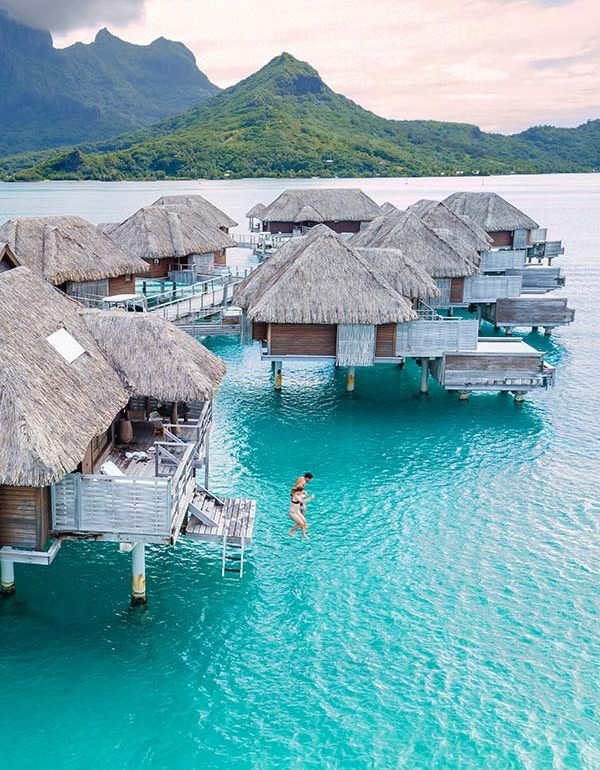
Bora Bora, French Polynesia: The beautiful white coral sands of Bora Bora are well known and they give the surrounding waters a unique shade of light blue, almost a turquoise blue. There is one beach on the island (again, many islands do not have beaches) and there are two over the water resorts. Snorkeling is excellent due to the clearness and color of the water and unlike some other islands, you do not need to worry about sharks or jellyfish. Aside from the two resorts, the main town is about two blocks in length and has several local restaurants/bars. Bora Bora has a legendary mystique to it but after visiting it, I can say “I was there” and that is that.
Tahiti, French Polynesia: Much more built up than Bora Bora but there are really only two modern hotels on the island and the island feels more cosmopolitan. We picked the Hilton and were not disappointed. As with most of the islands (except Bali and Australia), literally everything must be imported and thus prices are high. Champagne runs for about $150 or about twice the cost in LA and I would say that the cost of living is at least double that of LA so it can be a real sticker shock to someone from the mid-West or the South. During a discussion with a Frenchman (living in London), he found that a number of the surrounding islands’ facilities are showing their age, but then as with Bali, Covid was a disaster for the tourist industry.
General Thoughts: This was a great trip which was a real eye opener. You can try to imagine what it is like visiting or living on an island in the vastness of the Pacific, but you have to actually be there in order to fully understand how different island life vs. your world. Everything is seen through a different prism; travel, the cost of goods, what foods are available and affordable, sense of isolation from the rest of the world, opportunities for education, employment, etc. One needs to realize that the local inhabitants are descents of brave people who challenged the open sea in a quest for a better life, or a more peaceful life or for whatever reason. I don’t know if it was bravery or desperation, but their quest was a tale for the ages. You can lose track of which island had which town or beach or waterfall, and they can run together after time, but a trip such as this may surprise you in what you discover about yourself, your history and your life.
The best part of the trip was meeting so many of the locals and interacting with them. Their openness and kindness, real smiles and strong ties to family and religion are wonderful to see. It is easy to wish all the best for them.