
In June 1942, for the first time since the war of 1812, the United States was invaded. Invaded in an area where few Americans had ever been, on an island that even fewer Americans had ever heard of, but it was an invasion which had to be faced.
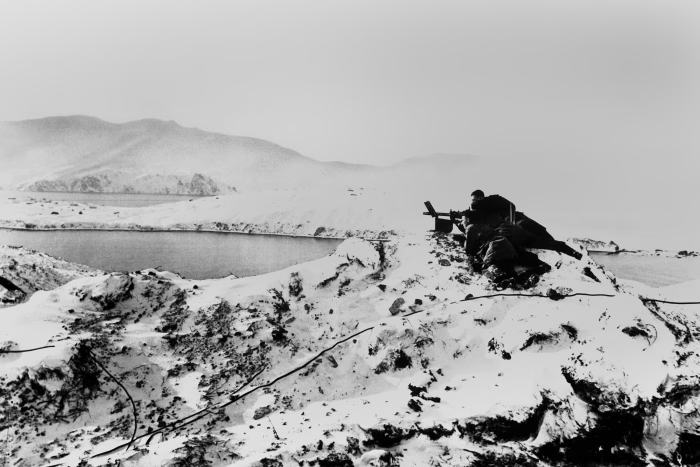
To mislead American forces from the main Japanese thrust in the Central Pacific, Japanese forces landed on the island of Attu, an island at the extreme end of the Aleutian Island chain. The island that held no tactical or strategic value, was racked by one hundred mile and hour winds that thundered down from the mountains and had an average of ten days of sun a year. Wet, cold and remote, tens of thousands of men would meet each other in mortal combat for not valid reason.
Beyond the battle however, this is a story about two men, one Japanese, one American. The men met in a split second, one killed the other, but their lives were forever bound by their love of America and duty to their native land.
Paul Nobuo Tatsuguchi was the son of Japanese Seventh Day Adventists who studied medicine in the United States and who came to love the country. The size, freedom, opportunity all promised all that he could wish and when he met a beautiful Japanese student, he married and began a family. Life was not to allow him to enjoy his opportunity however, as he and his little family travelled back to Japan in a successful attempt to free one of his sisters from prostitution to which she had been sold by the family’s elder brother during the worse days of the Depression. Then, Tatsuguchi was drafted into the Imperial Japanese Army (though he was mistrusted so much that he was the only doctor in the Army who was not an officer). Shipped to Attu with the invasion forces, Tatsuguchi was cut off from the world he loved and was subjected, as were all Japanese troops, to constant propaganda regarding the glories of Japan and his duty to the Emperor.
Dick Laird escaped the poverty of Appalachia by joining the U.S. Army where for the first time he had three meals a day, regular pay and a clean place to sleep. He met, impregnated and left a girl but during the war, he matured, went back and married her but he still had to pay his debt and fight his battles in the Pacific. One early morning, with a thick fog all around and in the middle of a Japanese suicide attack, Dick accidently killed a comrade and then killed Tatsuguchi.
Dick never really recovered from the battles he fought (he won the Bronze and Silver Star medals) and Tatsuguchi had left behind a diary which was circulated widely by U.S. troops even though it went against the image built up during the war which showed the Japanese are a deadly, sneaky crazy enemy who had no human feelings.
Many years later, Dick managed to find the family of Tatsuguchi and told them how he had killed their father/husband. How both sides faced the truth and what they learned is a great story. And, this book also brings out the sacrifices of the men of both sides who fought in one of the most hellish places on earth, in a campaign that produced the highest percentage of American to Japanese causalities until the battle of Okinawa.
This is a fine read, both for the military historian and for more personal aspects. Highly recommended.