

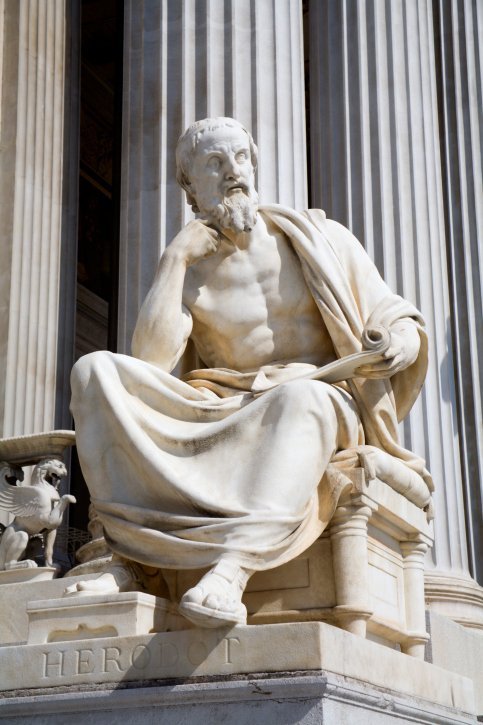
Herodotus according to Cicero is the Father of History. Does that mean that before Herodotus no Greek or Persian did not write history? Hardly, but Herodotus brought discipline to the subject by going out and speaking with locals, comparing their stories, examining the area of which he was writing and then drawing a conclusion as to the validity of any given narrative. This may not sound terribly new or exciting, but remember that he was writing history of the Greek and Persian wars around 460 B.C.
The book itself can be a hard read; imagine reading a novel by Alexander Solzhenitsyn, only instead of Russian names you have ancient Greek names (with no modern equivalent) and the story is in an area of the world where the locations have entirely different names than the areas are called today. Added to that, there are numerous “tribes” and “nations” that are long gone and that you have never heard of before in your life. Yet, in this translation (by Tom Holland), there are traces of wit and even sarcasm sprinkled throughout the six hundred plus pages. One learns from practices and a view of the world that sound strange and often silly, yet they are no sillier than the fears that the sailors of Christopher Columbus’ time had as they embarked on those voyages.
To be sure, historians after Herodotus have taken him to task. An example is provided by the German military historian, Hans Delbruck when he questions if Xeres could really field and army of 4,200,000 men. In volume one of his History of the Art of War, Delbruck points out that a German army corps of 30,000 men covers about fourteen miles even without its supply train. Given that modern fact, Xeres army would have a column of march of about two thousand miles! Additionally, Delbruck uses other historical records to shoe that certainly the numbers on the Greek side could not be realistic due to the known population of various cities at that time. Further, Delbruck questions the battle tactics as described by Herodotus, especially on the Greek side given the distances and the weight of their armor. Yet even with his numbers and logic, the detailed description of the Persian and Greek forces is excellent and believable.
To his credit, Herodotus presents an entirely different picture of the Persian king, Xeres. Contrary to popular history, Xeres is presented to be a brave, loyal and wise ruler, willing to take counsel and suggestions from those trusted individuals around him. He certainly must have been an interesting individual in an age of petty lords and tyrants.
I found that the best way to read this enjoyable history was to take it in small doses; a few pages so that the names and locations do not overwhelm the enjoyable writing. There are age old lessons to be learned from this book; nations and peoples come and go as other peoples move due to famine, drought, or pressure from other peoples; bravery in battle is honored as is loyalty and honesty, and war is and shall always be with us. This is the perfect book to read while one has a good cigar, a fine beverage, a comfortable seat, and the time to savor what one learns.