
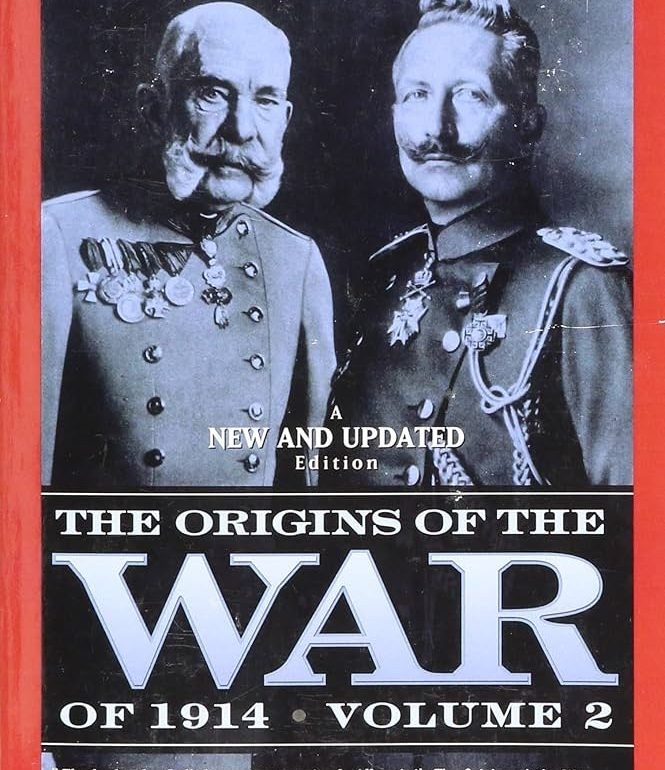
First published in 1942 in Italy, Luigi Albertini’s The Origins of the War of 1914 (three volumes, about 2200 pages) traces the political, diplomatic, and military causes of the war, going as far back to the compromise between Austria and Hungary in 1867 and its impact which would ripple through Europe for decades. He takes the reader step by step along a path that ends in war. The way he lays out the events in Europe, one can see with the advantage of hindsight how so many European decisions naturally led to war.
The work itself is recognized as one of the two or three most important books on the subject and Albertini provides the reader military and diplomatic dispatches, notes on policy meetings held by France, Germany, Russia, and other nations. We are exposed to the lies, corruption, political back biting and conflicting interests of the leaders of nations and those who serve them. Just as today we face what is known as the “deep state,” in nineteenth and early twentieth century nations, generals, bureaucrats, industrialist, and others followed their individual interests, often at the expense of their own nations.
Humanity with all of its weaknesses and faults parades before the reader who is left shaking his or her head at the sheer number of foolish decisions. There is little nobility to be seen as:
• We see the stupidity of the Russian Czar who did not realize that he could not mobilize only a portion of his forces and the generals who lied to him.
• We see the Italian leaders who dreamt of expansion in the Balkans with the result that they sold their nation to the highest bidders.
• We see the German Kaiser, known for his bluff and bluster who pales as he realizes what is about to be unleashed thanks to his overweening ego.
• There is the Kaiser Franz Joseph, an old, tired man used by his Chief of the General Staff into issuing an ultimatum which no nation could accept.
• The assassin, Gavrilo Princip never regrets unleashing a war that would lead to millions of deaths and would open the door to a second war with tens of millions of dead, all in the name of a “Greater Serbia.”
• Britian’s Secretary of State for Foreign Affairs, Sir Edward Grey did not realize the danger Europe faced even though his nation had been in a naval race with the strongest land power in Europe.
• France fueled the rearmament of Russia in order to encircle Germany in a war of revenge using tactics that had cost them the last war with Germany.
There is no end to the players who each did their part to bring on the war. The list of long forgotten European foreign ministers, generals and officials can be daunting to keep straight precisely because none of them acted in a responsible manner, one which would slow down the slide to war.
Nations and their leaders have long memories. A quick decision by one nation can lead to a grievance of another that will last for decades. Yesterday’s allies are tomorrow’s foe for as Charles de Gaulle said decides later, “Treaties are like roses and young girls. They last while they last.” Unfortunately for Europe, the treaties of both sides were honored and paid for with the blood of millions.
Barry J. Klazura
With a Masters Degree in Guerrilla Warfare and Totalitarianism, Mr. Klazura was well prepped for a career in Sales and General Management, consulting on corporate startups and turnarounds as well as lecturing on history and politics. For the past twenty years he has focused on being a financial advisor and consulting.