
Before his death in a car accident in 2007, David Halberstam wrote over twenty excellent histories. His attention to detail and accuracy were hallmarks of his work and this enabled the reader to become immersed in his telling of history. I first was introduced to him by reading The Reckoning which traced the decline of the American auto industry under the assault of the carmakers of Japan. He is perhaps best known for his analysis of the origins of the Viet Nam war in The Best and the Brightest where he reviews the actions of the “Whiz Kids” of the Kennedy and Johnson administrations.
The book he was most proud of is The Coldest Winter. In it he not only discusses the failures of the U.S. military, the arrogance of Douglas McArthur and the weakness of the Truman administration in the face of the legend of McArthur, but provides the perspective of those on the sharp end of the bayonet; the common infantryman, squad leaders and others who fought a wily and driven enemy.
Having just a few short years before beaten the Nazi and Imperial Japanese war machines, one asks how such a vaunted military could perform so poorly against an enemy inferior in every measure of military strength except manpower. The answer lay in arrogance, upper echelon officers who kowtowed to McArthur and inflexibility in meeting not an enemy on the level ground of Europe, but one who fought in the hills and mountains of Asia.
There are few officers who come off well in this book. One of the few is Major General O.P. Smith, the commander of the First Marines during the battles near the Chosin Reservoir. Resisting orders to scatter his forces in a vain attempt to constantly push forward as directed by Tokyo (McArthur’s headquarters), Smith instead kept a firm hand on his excellent troops to make sure they knew they were acting as a team and were not cut up into weak and exposed positions.
Another leader who stands out is Matthew Ridgeway who was a rising star at the end of World War II. Ridgeway managed on infuse morale into an all but defeated American army through his personal style of leadership. He was seen everywhere; at the front lines, at the chow lines and others, always talking to the troops, listening to them and making them feel that he had their personal wellbeing in mind. At the same time, he demanded much of them, but unlike McArthur, he could be seen, his presence felt and his insistence of getting the troops off the roads and into the hills where the enemy hid and hit from, brought out the best in the troops.
Finally, there is the question of why President Truman put up with the disrespect and insubordination of McArthur for so long. Truman had to put up not only with McArthur, but also with powerful D.C. politicians who saw McArthur as a replacement for Truman and this meant a divided national will. With the successful turn around provided by Ridgeway, Truman was finally able to take decisive action and relieved McArthur.
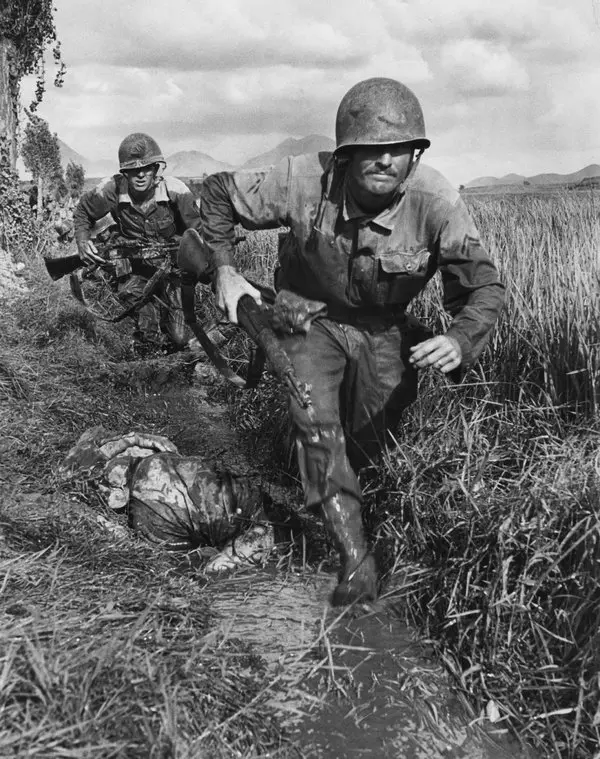
The finest part of this history however, is page after page of personal experiences by American troops. You will feel drawn into their lives as they fought, often wearing summer uniforms in sub-zero temperatures and suffering from bad logistical support against human wave attacks, day after day, with seemingly little regard for the enemies’ losses. At the same time, given the vivid descriptions provided by Halberstam, one can only image the miserable conditions of the North Korean and Chinese “volunteers” who were driven forward by Communist commissars. Those troops, often barefooted and having even worse support, were simply cannon fodder used by a system that could always count-on hundreds of thousands of poorly trained but docile replacements.
If you read only one book on the Korean war, make it this one.