
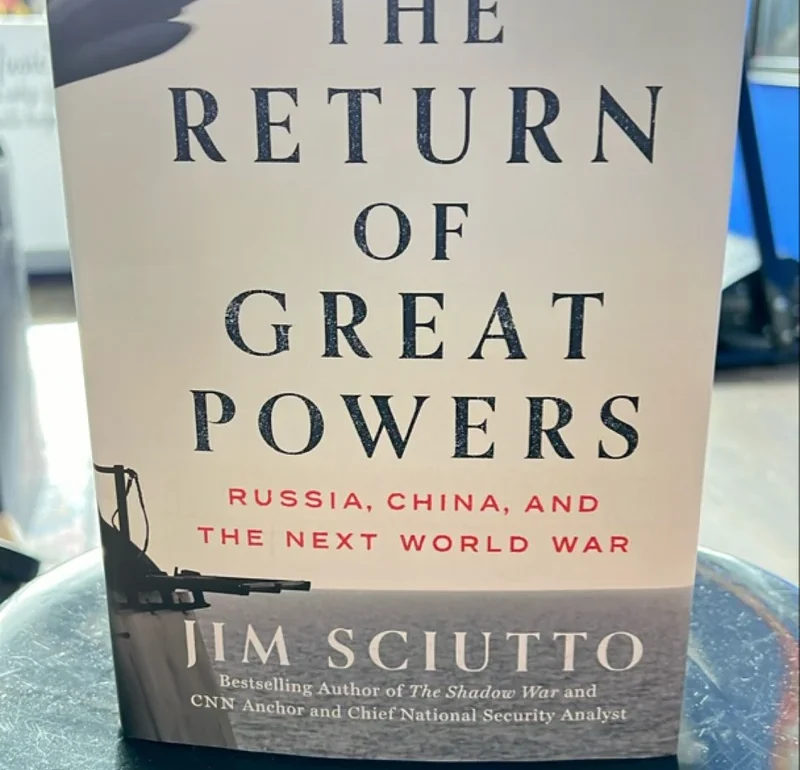
Jim Sciutto is CNN’s chief national security analyst as well as anchor of CNN Newsroom on Max, airing Monday through Friday afternoons. He has reported from over fifty countries including assignments in such challenging countries as Iran, Iraq, and Afghanistan. For this excellent book, he has pulled on his many years of experience and connections, interviewing dozens of intelligence officers, politicians, fellow news correspondents and others.
His premise is that although some thought that the fall of the Berlin Wall in 1989 would herald what Franics Fukuyama called “The End of History” (how will he ever live that phrase down?). Sciutto instead says that we may well be facing a 1939 moment. The reason is that powerful nations continue to act in their perceived best interests. John Kerry amazingly said after Putin first invaded Ukraine, “You just don’t in the 21st century behave in 19th century fashion by invading another country on completely trumped-up pre-text,” Kerry said. “It is serious in terms of the sort of modern manner with which nations are going to resolve problems. There are all kinds of other options still available to Russia.” He sounded like a Western European leader who had lived under the U.S. umbrella of protection for decades and had come to believe in their own moral superiority; “we just don’t do those kinds of things.”
In this book, Sciutto discusses numerous potential “flash points’ around the world, including the Baltic countries, Taiwan, Ukraine, Africa, and others including the possibility of the use of tactical nuclear weapons which is part of the Russian military doctrine. He examines the steps taken by China’s XI and the challenges he faces with a faltering economy after consolidating so much power into his hands, thus losing the cover of “collectivism.” In each of these examples, he often goes a step further and asks or presents the “next question,” which sets him apart from the talking-heads we see all the time.
He also briefly discusses the kabuki dance that goes on between intelligence services and the press. For some reason, the press seems to believe that they should be privy to everything the intelligence services know or are investigating while expecting the gathering of intelligence to be a cut and dried exercise. When intelligence misses an event, such as the Russian invasion of the Crimea, the press is sure to criticize, and such an error makes the press more critical of the process. At the same time, intelligence views the press as a group only interested in “selling papers” and a group incapable of understanding how intelligence works. Finally, there are world leaders who are skeptical of both the press and the intelligence community, preferring to believe their own individual prejudices and wishes in place of contrary information.
I would recommend this book for anyone who needs a course in critical thinking. The step-by-step technique Sciutto uses to present his case is refreshing. It would be interesting to know if and how many members of the press have read this book and if they did, how they would review it.