
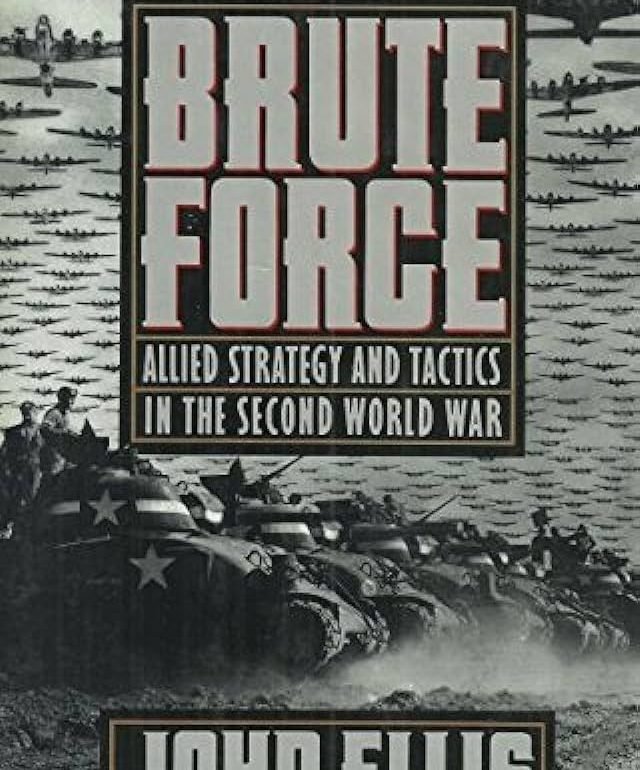
There is a scene in the movie “Patton” where he is standing as a mass of tanks, trucks and men roll past him toward battle. As that might fleet of metal giants roll past, he says to himself, “God forgive me, but I love this”. By this, he means the feeling of power, the sheer force of the military as it goes to meet the enemy. But how did that mass of steel come to be? How did all those men manage to be housed, trained, fed, clothed and armed. This book tells part of the story; it is a story of the might of the United States, a country late to the war and how it mobilizes its resources to provide the materials for victory.
In a mass of charts, graphs and columns of numbers, as well as an excellent overview of campaigns from the steppes of the Soviet Union, to the Atlantic Ocean, to the vastness of the Pacific, Ellis overwhelms the reader with the productivity of the American system. The materials which overwhelmed the Germans and Japanese did not spring from the earth overnight and the strategies which finally provided victory were not designed to end a world war quickly. Unlike the Germans, where centralization and local power struggles stifled production, the U.S. managed to harness the individuality of the average American in a patriotic and profitable way to go to war. The Germans thought they could win, the Japanese hoped for a stalemate, but the Americans knew they could win based on their individual contribution to the war.
In the end, logistics won out. While the average Japanese soldier or sailor went to war with four pounds of logistics to back him up, the American went to war with four thousand pounds of logistical support. While Hitler laughed when FDR said the U.S. could produce 50,000 airplanes a year, in 1944 the U.S. produced over 91,000 aircraft. But it was not enough to produce those planes, not enough to produce nine times the trucks that the Germans could produce, not enough to produce two to 10 times as many tanks or artillery pieces as the enemy; no, you had to keep they maintained. While the Japanese were able to put into the air 150 planes, the U.S. was able to put up over 1500. The Japanese had a total throughout the war of some 35,000 flying personnel (not all pilots) while the U.S. by 1944 had graduate 226,000 pilots alone and nearly 1,000,000 mechanics for all the armed forces. In the end, the Axis powers were swamped beneath a flood of men and material that they could not hope to match.
The one weak point of the book is that it does not explain how a nation which entered the war with an army about the same size as that of Belgium (the United States), was able to produce all those tanks, planes, ships, etc., when the lead time is normally eighteen months to switch production. This is especially true today with our leaders tell us that orders for munitions from our allies, such as Taiwan will take two to three years to fulfill. How is it that we do not have the ability to equal the effort of the Second World War? Has our manufacturing base been so degraded? Do we lack the techincal or financial expertise? If so, given the means available to those who oppose us, are we unable or unwilling to shift priorities to provide the protection to our homeland in these dire times? That story, exciting is told in Freedoms Forge; it is the story of capitalists like Henry Ford, Henry Kaiser and Bill Knudsen. Taken together these two books create the story of the might of the American system even during the time of the Great Depression. If you are prepared to be astounded by the force of Ellis’ numbers, Brute Force is an outstanding read. Even if you are not, it is inspiriting as it shows what is possible in a free society when there is strong and united leadership.