
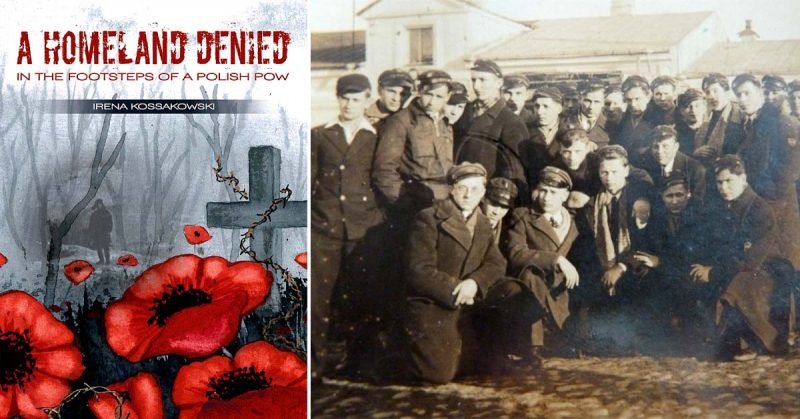
As we are growing up, we have a tendency to either ignore or tune out the stories and experiences of our parents. We think their ideas are so old fashioned, or that their experiences do not impact on our lives, little realizing that their stories and memories are in reality subtle learning tools for us to lead better lives. Later, when they are old and we have families and real lives of our own, we sometimes ask them about some memory or story they mentioned years ago, but with failing memories or sadness caused by those stories, they may be reluctant to dredge them up. We then are sad and realize that experiences in their lives will be lost forever and that someday, we shall be like them, trying to remember the good and trying to keep their sorrows and mistakes buried.
This book was written by a woman whose father (Waclaw=Walter) was 19 when Poland was invaded by the Nazis and Communists. Barely two weeks into cadet school, he was captured by the Soviets and like 3,000,000 other Poles, was shipped off to a gulag camp in Siberia. Along the way, tens of thousands died from malnutrition, disease, beatings or simply giving up. But he was lucky, for unlike tens of thousands of Polish officers, he was executed in the forests of Katyn, hands tied by a bullet to the back of the head and thrown into mass graves (over 10,000 were executed by two executioners!).
When Germany invaded the Soviet Union, the Soviets offered to release some of the Poles so they could fight for Stalin against the invaders. Another young man, standing next to Irena’s father, after surviving years of cold, hard labor and beatings said that he would not fight for Stalin and was immediately executed with a shot to the head, splattering brains and blood on everyone around.
Finding his way to Iran over several months (no money or food was provided to the men on their journey), he was nursed back to health by the British army and enlisted in the Polish Corps which was to fight in Italy. He fought in the battles at Monte Cassino, Ancona and Bologna and at the wars end managed to emigrate to England as going back to Poland would have been a sure way to be executed as a spy.
He was not able until about 1966, and still at risk, to go back to Poland for a visit, to see his mother (his father had died), the girl he had dreamed of throughout the war, to see the farm on which he had grown up on, etc. All the while, despite the continued nightmares of the gulag experiences, he never really spoke of his earlier life and it was only when Irena was a grown woman did you begin to gradually pull the story of his life from him, bit by bit.
This little book is a sobering look at the mostly unknown brutality that millions endured at the hands of the Soviet Union as they attempted to destroy the will of a nation instill a system of government in which the individuals only purpose was to serve the all powerful state. The idealism of the early 1920’s had been long crushed by the slaughter of the kulaks, the collectivization of the farms and the bloody purges of the Party and military. Poland, like the other countries of Eastern Europe were given to the Soviets by Churchill and Roosevelt (one did it from practicality, one from personal indifference).
If nothing else, after reading this book, you may sit down with your parents and gently listen to some of the stories and lessons their offered when they went in one ear and out the other during your youth.