
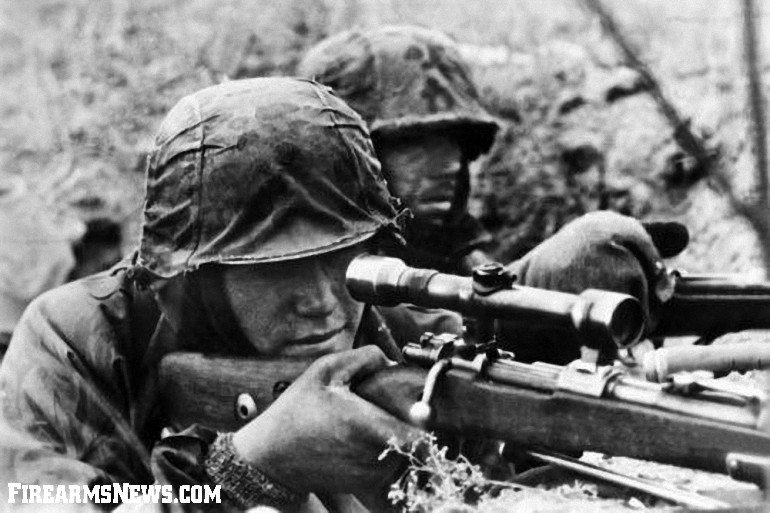
From July 1942 until the end of the war, Sepp Allerberger was a sniper fighting against the Soviet Union. During that time, his official tally of 257 confirmed kills, made him the second most deadly sniper in the German Army (the record of 345 kills was held by Mathias Hetzenauer). It is important to note that a sniper “kill” had to meet certain requirements, such as it had to be done during an actual sniper assignment (ordinary defensive or offensive kills are not counted) and must be confirmed by either an officer or an NCO. Allerberger states only that his individual kills, taking unconfirmed sniper kills was much higher.
Allerberger did not come from a military family; his home was a small village on the Austrian side of the Bavarian Alps near Salzburg. He was drafted at the age of eighteen and trained as a machine gunner. After his first battle, he realized that he was a marked man for machine gunners were prime targets of the enemy. He decided to try for a safer job and accidently found out that he was an excellent shot. As the German Army was behind the Soviet in the development and training of snipers, it was a “learn as you go” decision. He quickly learned the trade and was highly valued at the front where many assignments were to kill his Soviet counterpart who was causing losses in his vicinity. Sniper to sniper battles pit individual skill, patience, and determination at the personal level and yet Allerberger does not exhibit any emotion other than pride for his victories.
As noted, all kills had to be confirmed and that could be a problem as many in the German Army felt that being a sniper was a “dirty” job. Hiding, sneaking up on the enemy, killing when ever possible, including when a soldier is going to the bathroom carried a bad odor. This view extended to the artillery officers who somehow believed throwing a high explosive shell miles at an unseen and unsuspecting enemy was more “honest”. For the infantry, enemy snipers were hated thought to fight dirty, but their own snipers were well liked and protected. War has its own value system.
Given that many snipers were killed after 15-20 shots, his score is amazing. He seemed to lead a charmed life, receiving no major wounds, and suffered only minor scratches. His detailed descriptions of many encounters are excellent, and one clearly see the barbarity of warfare on the Eastern Front.
His story brings to light the mentality of an army in retreat. Months of constant retreat and serious losses in manpower and equipment left the average soldier demoralized, dirty, hungry and constantly looking over their shoulders at the Russians who seemed to have unlimited resources. During the retreats, seriously wounded men were left behind even though everyone knew that the oncoming Russians would at best, quickly kill them or more likely, torture them before killing them. One has to remember that the Russians were not only out for victory, but also for revenge for the deeds of the Germans on their homes and loved ones. It was a war with little or more mercy. Often, the Russians had more to fear from their own officers who subjected them to beatings, penal battalions and early on in the war, cases of cannibalism.
This is only the third book I have read by a veteran which reflects a certain mindset. Ernst Junger’s Storm of Steel is one example, another is by an American, James Megellas’s All the Way to Berlin. Reading their stories, one sees an individual who calmly picks up a weapon, kills will great proficiency and then afterwards, go on to lead a normal life. They offer a fascinating view of war by very uncommon men.