

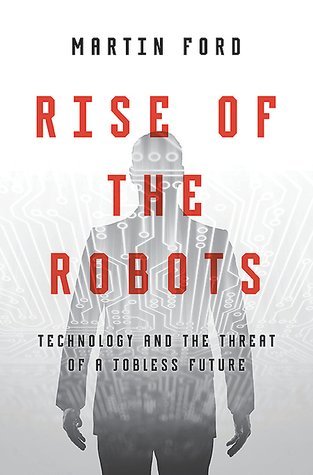
The fact that this book was published in 2015 made it that much more attractive to me. Here was an opportunity to learn more about robots but more importantly, it was an opportunity to see how accurate an author and techie who has been involved in the computer industry for twenty years could be with his projections and forecasts. I found unfortunately, that the field of robotics has moved in many areas, even faster than he predicted, while in other areas, he was right on target.
In chapter and verse, Mr. Ford lays out specific areas of human industry and demonstrates how the robotic industry is developing answers as to how to replace humans with devastating effect. While we think of how the auto industry has been revolutionized by robots, we forget the lost jobs in the industry and don’t draw a conclusion about other industries. Think again!
While the initial reaction to a computer besting Garry Kasparov in chess was shock, after a while it seemed almost expected as people began to understand that it was a matter of programing the computer with a finate set of options. What is more difficult for the human mind to accept however, is that we ourselves with our rational ability and physical dexterity might be replaceable. Could a mundane yet physically demanding job which requires judgment on physical actions be done by a robot? Look at an Amazon warehouse; acres of shelving, reaching stories high hold thousands of items in different sizes, shapes, colors, etc. Busy worker bees race around on scooters or roller skates, picking items for orders. Each order might consist of one item or fifteen widely separated items, it is a bookkeeping and inventory bowl of spaghetti. Is it possible to replace a human who can make on the spot adjustments in stacking pulled items so that the pile of orders does not topple over in transit and create a roadblock to other workers. The answer is yes; robots have been designed and are currently in use who can read the order, follow the map of the warehouse to the shelves for the goods, physically pick the correct item no matter its shape, size, or location, stack it the transportation vehicle, adjust each box so they fit the most efficient and take it to the next step. Robots cannot only do the job, they can do it faster, more efficiently and at a lower cost than a human worker. No more taking breaks, bathroom time, meals, vacations, etc. while not needing costly dental or medical coverage and they can work non-stop for a full twenty-four hours with minimal maintenance.
What other human jobs might robots be able to perform in the future? How about fast food preparation, dispensing of medicines at pharmacies, operations on humans, medical diagnosis in a manner that is faster and based on more information than any doctor alive can possess, elder-care for the elderly, self-driving autos to replace manned taxi services, defending our nation by flying jets faster and in such a way that a human pilot would die, writing sports columns, etc., the list literally goes on and on. Oh wait, those examples above are already being done by robots. After all, why would you pay a pharmacist over one-hundred thousand dollars a year for eight hours of work when you can have a robot do the same job on a 24/7 basis? In short, there are few jobs currently done by humans than cannot and will not be done by robots.
While there will be benefits to such a move, it will simply displace and make unemployable literally tens of millions of humans. A leader of China once said that his first though in the morning was “Today 60,000 new Chinese children will be born; what jobs will they have in eighteen years?”. If he were to have that same thought today, his answer would give him more of a headache. Where will tomorrows young people learn the basics of being on time, teamwork and a sense of self-worth when working at a fast-food restaurant, big-box store or the dog walking service will be taken over by robots? Try to think of some job or profession which eventually cannot be replaced by robotics. Car mechanic? Autos today are run by computer and many times rather than repair a part, the old one is pulled out and the replacement can be plugged in. If that is the case today, imagine the mechanics job in five or ten years. The list goes on and on.
In effect, much of this book is an argument for a guaranteed income. With the withering of jobs, millions of humans will simply be useless. How are they to live? What will be their value? How will they be cared for and what will they do day in and day out? In effect, the economy as we know it today, may very well disappear. Robots produce, but they do not consume, so the cost of production may decrease but the ability to earn an income will decrease. Since the Capitalistic system has created so much wealth, mobility and freedom, a decrease of Capitalism will lead to a top down, decreasing economy; it has been that way in every top-down society and the trend will only accelerate in the future.
Will our future either be something as pictured in the movie Soylent Green or in The Time Machine? Either option is not attractive, but will we have the will and strength to avoid those options and allow future generations an opportunity to fully experience the true human condition with all its joys and pains?