
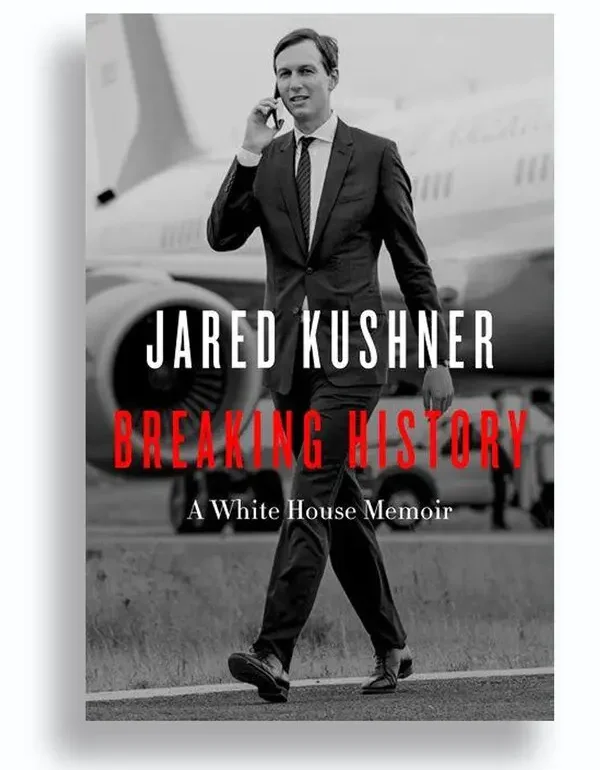
I must admit that prior to reading this book, I had mixed thoughts about Mr. Kushner. Was he a case of nepotism, what was his background, did he have any thoughts of his own or was he merely a puppet of the President who was his father-in-law, did he marry into the Trump family in a bid for easy wealth, and so on. By the end of the book, admitting that it may be at times self-serving (how unusual for a political memoir), my attitude toward him turned to admiration.
Here was an individual from outside the belt way who took on tasks which were not easy, fought against individuals with their own agendas and who did not necessarily supporting the goals of the man they worked for, the President, entered into the very real dark and self-perpetuating deep state and came out with his love of country intact, his family intact and could realize that he helped to accomplish successes where “insiders” had failed for decades.
How was he able to accomplish anything being an outsider in the Capital. For one, he brought a level of expertise that was missing in the Capital and the hallways of power, for rather than trying to merge into the bureaucracy and traditional power games, he brought his business sense to the table. This means that as every businessman knows, you cannot move ahead if you do not offer a good product and work at every level to provide that product to the market. His approach was very often one of being willing to listen. An example is the dogma given by John Kerry that “There will be no separate peach with the Arab world without the Palestinian process and Palestinian peace. Everybody needs to understand that. That is a hard reality.” Kushner realized that the same old programs with ill-defined promises had been the bedrock of Middle East discussions for decades with the same result, failure. Instead of doing the “same old, same old”, why not do something different. It was Henry Kissinger who advised him that the foreign policy of the nation had to be run by the White House as opposed to the State Department where ideas seem to go to die.
While Trump may have been mocked by the Germans and others when he cautioned them about relying on cheap energy from Russia, in the Middle East he was respected for his openness and willingness to be bold and speak openly. His image played well in the area as opposed to the apology tour concept and he was willing to listen to what Arab leaders had to say in very frank discussions, including when he told them that a deal could be made but that they had to handle the terrorists in their own countries who go out and murder Israelis. No action, no deals. The Arab leaders also liked that Kushner was the President’s son-in-law which gave creditability to his voice. Finally, he found by listening that a major stumbling block to Middle East movement was not necessarily the Palestinians who were getting to be a burden, but rather guaranteed and safe access to the al Aqsa Mosque which was under the control of Israel. By finding the one thing that all the Arab leaders could agree on, it enabled him, by working hard and creating a strong team, to develop and close the Abraham Accords, an action that has led to greater trade and development in the area.
The book notes some of the personalities in the administration including Tillison, Kelly, Fauci, Bolton and others in a way that allows one to read between the lines and understand his opinion without being insulting. In each encounter, Kusher seems to better realize the difference between the government game and that of business, but he absorbs each and uses the experience to better his results.
One of the finest sections is in the episode regarding the successful strike against Soleimani. The Iranian general had been responsible for the deaths and wounding of thousands of U.S. military personnel and Trump felt that a message needed to be sent that there was no safe ground for those who attacked Americans. The killing of Soleimani sent a strong message to the Iranian leadership and despite the threats made by that leadership, their reaction was one that was feeble at best.
Other chapters cover Operation Warp Speed, the bi-partisan passage of the First Step Act, and of course, the wasted energy over the Russian collusion investigation.
In the end, I believe most readers will put the book down and believe that Jared Kushner, a religious and strong family man, put his best efforts into projects during that four year period. He is proud of his accomplishments and the service he provided to the country and at the same time, it is easy to understand why he has openly stated that he would not wish to go back to such service again. Somehow, we need to create a system where good and honest individuals can enter government service, and not face the possibility of huge legal bills created by political gamesmanship, where new ideas can be put forth after decades of failed policies. This is one of the best post-Administration memoirs I can remember and it does provide hope for the future.