
Several years ago, I read Luigi Albertini’s massive, three volume, 1800-page work, The Origins of the War of 1914. It was a heartbreaking work as it laid out a chain of events beginning about thirty years prior to the outbreak of the war which seen from today, clearly pointed to the start of that terrible war. Misunderstood actions, political snubs and fumbles, conflicting personalities, etc., seem to drive the Western powers toward a cliff from which none could turn.
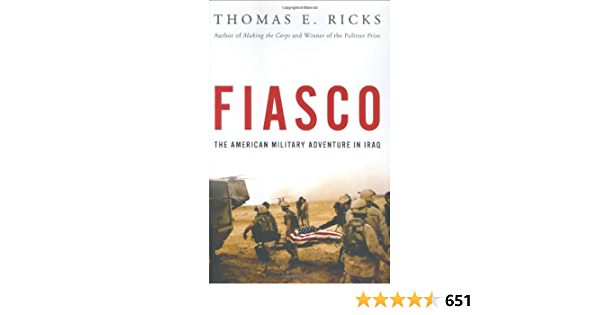
In a sense, this book gives one the same feeling, only you reach the conclusion by about page 80; you want to put the book down and wonder how so many poor decisions could be made by so many policy makers and leaders. Anybody with even a rudimentary knowledge of asymmetrical warfare, can see the fundamental errors which turned a solid opportunity into a fiasco.
What is amazing is that many of the military leaders who had fought in Viet Nam and who had vowed never to make a mistake like that again, went along with political leaders and committed basic errors during and after the initial invasion; inadequate troop strength, ignorance of the culture, disruption of the economy which led to many military Iraqis joining the insurgents simply to put bread on the table, poor training of the infantry, disregard of the lessons of local control learned in Viet Nam, etc. managed to alienate the populace and actually feed the insurgency.
Ricks blames most of the problems on Donald Rumsfeld, Paul Wolfowitz, and L. Paul Bremer III as they ignored advice which did not agree with their preconceived ideas and amazingly enough, they had no plan for what to do with Iraq after the military victory. There seemed to be some sort of mystical belief that our occupation would be short lived and that some sort of civilian leadership would arise that could span the Sunni-Shite-Kurdish canyon and run a government which had been an authoritarian state under a suddenly outlawed political party. Bremer managed to put out of work the entire Iraqi army, the key bureaucrats and destroy any hope for central power to run the country. For this, he eventually was awarded the Presidential Medal of Freedom, along with George Tenet and General Tommy Franks, both of whom managed in their own way (intelligence and military) to mislead or misdirect the war and occupation. Professionally written and documented, the weakness of this book is that it ends in 2006 and the author, entirely misses the options from that point forward. He could not see the rise of ISIS of course, but his discussion on the political options read as if he were in a hurry to finish the book. This should be a must read at West Point and for at least the top ten percent of the “leaders” in Congress and the bureaucracy. Just be prepared to put the book down every few pages and shake you head in wonder at the foolishness, stupidity, and ineptitude of those who wield such power.