

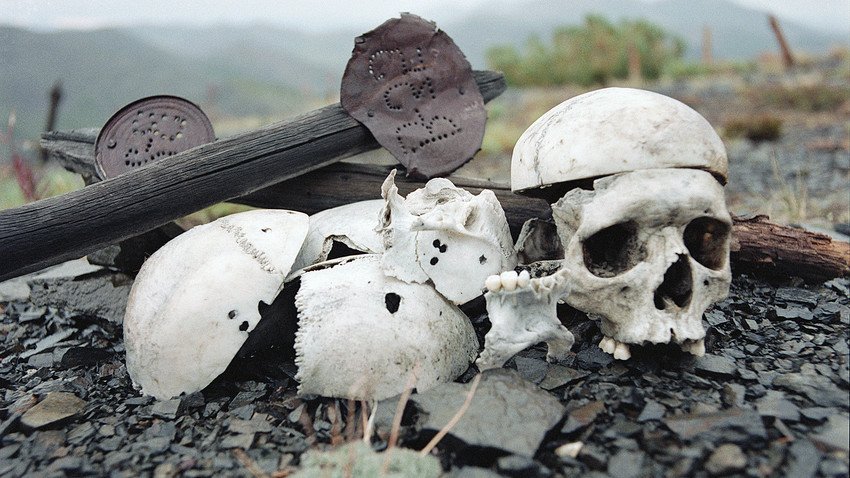
The Magadan area of Siberia is known for its harsh climate, where the weather is sub-zero for up to six months a year. Now picture that you are in that climate, working in a lead or gold mine (which tend to kill its workers in about six months) in a thin cotton jacket and wooden clogs. You want to get a better job, but you have nothing to trade to the criminals who run the camp with the approval of the military guards. Your diet consists of a cup of hot water for breakfast, perhaps a slice of bread for lunch and if you make it back to the barracks in time, a cup of hot water with perhaps a fish head or a bit of turnip. Then after lights out, you wait for the criminals to rob you of your blanket or gang rape your bunk mate. If you do manage to get out of the mines, you get a better job such as cutting trees for 12 hours a day. You do not know what has happened to your family (as you are held without the right of correspondence) and you realize that that routine will go on for the length of your sentence, which is probably fifteen to twenty years.
When you do come out of the camp, you may not receive a permit to return to the town where your family lived and there are few ways to contact them. In fact, everyone who encounters you shuns you as being seen with a former “political” may be reason enough for them to be arrested. There is a good chance that your children were put in State orphanages and had their names changed so there is little possibility of ever finding them. In fact, you have only a small chance of ever leading a “normal” life.
This then was the story of this early work by one of the premier historians on the Soviet Union. Conquest lays out a story of brutality that is an important part of the Gulag system of the Soviet Union. And, as terrible as the above description is of life in the camps, it was worse for the women who were sentenced to the Gulag. From mass rape on the transportation to the camps, to forced lesbian relationships in order to gain a bit more to eat, women were the lowest of the low in the system.
It is often said that the camps were not the fault of the ideology, but rather the fault of the leaders. But what type of system would allow the leaders to develop a system staffed by hundreds of thousands of brutal individuals who could live and work in a system like the Gulags. What type of system would allow to be created a system of laws and regulations where people are arrested and convicted based on nothing more than a quota for arrests and, in some cases, being picked out at random from a telephone book.
Each time I read something on the Gulag system, I thank my lucky stars for the life I lead, in the country where I live which is a true anomaly in the history of mankind. There but for the grace of God, or the decision of my grandparents could have gone I.