

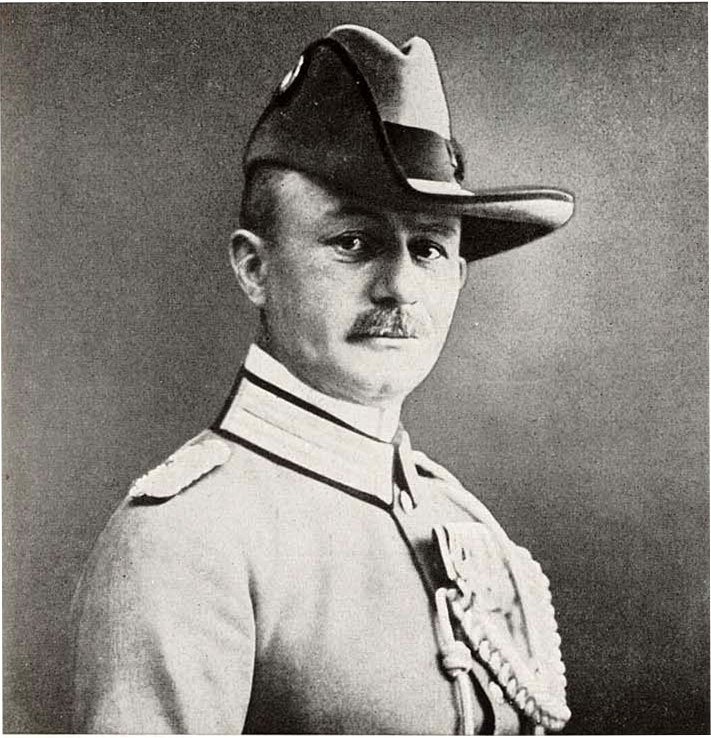
From the outbreak of the war in August 1914 until the end, November 1918, Major Paul von Lettow-Vorbeck led a small group of German troops and militia and 10,000 native Black Askaris in a campaign across much of central Africa. Cut off from his homeland, he and his troops lived off the land and the supplies they were able to capture from the British who were charged with capturing or destroying his force. What should have been an easy campaign against the small German force turned out to tied up 300,000 British Empire troops commanded by 130 generals which were needed in the European theater.
Always staying one step ahead of the British and often taking the fight, successfully to the British, the Germans had to not only survive the battles, but live in a climate of extreme heat, lack of water, diseases and insects which could infect a man with a disease that could cause death in a single day. Without a source of steady supply, the Germans resorted to sneak attacks on supply depots for food, shoes, medicines, and clothing. Slowly the two thousand Germans were whittled away through battle and disease, yet they survived in part because they learned to move like the natives in small, fast groups with a minimal of supplies while the British relied on slow moving columns followed and hindered by thousands of camp followers.
When the war ended, von Lettow-Vorbeck thought that the news might be a British trick, but he was finally convinced. The biggest problem came from his Askaris who could not understand why they had to surrender as they felt they were winning! In the end, the native troops almost started a rebellion but were finally convinced that they had to go home. Unfortunately, they were treated poorly by the British who exhibited a
very racist attitude which they carried over from their treatment of the natives in India.
This is an excellent history of a campaign which has been largely overlooked by historians. It is a shame that the author did not cover the history of the German rule in Africa as it was both better and worse than that of the French and British. Better in that they created more schools and hospitals for the natives than the other Europeans but worse in that the Germans put down a revolt in 1905 that cost the lives of 300,000 natives. Despite the brutality of the German response, there was never any problem with the natives who served with the Germans during World War I.
A small book that demonstrates the human spirit and ability to survive against great odds.