

The Russian army has had moments of brilliance, such as the defeat of Napoleon and the logistical miracle of following him from Moscow to Paris. There is no doubt that the army which was responsible for ninety percent of German losses in WWII (thanks in large part to the supplies provided by the U.S. and the U.K. at no charge) played a key part in the defeat of Hitler.
Today however, we see a Russian army that sadly fits the stereotype in many people’s minds; poorly trained, led and equipped. Once again, without total mobilization, the Russian army is simply too small and poorly led for the job of defending its immense country.
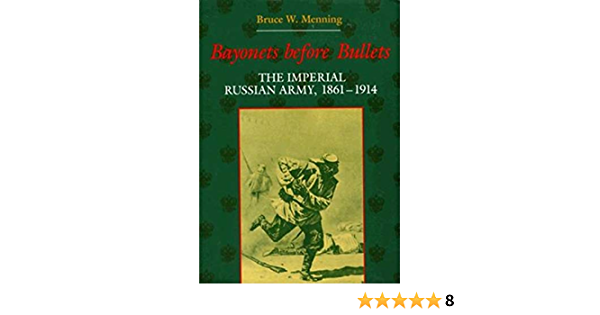
Is the stereotype accurate when looking at the Russian army currently in the field? This book helps to put the challenges of that army in an historical context.
With the defeat during the Crimean War, the new Czar realized that his army while large, could not compete with those of other European nations. Thus began, over the next 50 years, attempts to update the military skills of the officer corp., the weapons, training, etc. of the entire Imperial Army. But serious questions arose and continued to rise as rapid changes in military technology raised doubts about long held beliefs and new theories of the military art. Those same questions would worry the military minds of other European powers. To give a couple of examples:
- The old theory was that the troops would line up for attack at 250 paces from the enemy, but with smokeless powder (hence a longer range), that distance began to expand to 500 paces, then 1000 and eventually over a kilometer and a half from the enemy forces. This meant that the killing ground was expanded and what steps could be taken to minimize lives?
- Along with the infantry, direct fire artillery since the time of Napoleon had played a major part in any attack or defense. But with the longer range of infantry weapons, the artillerist was more open to withering fire so new tactics such as indirect fire had to be worked out.
Many officers had theories to answer these and other questions, but at the same time there were vested interests which refused to acknowledge these and many other problems. Top generals, who fought during the Napoleonic wars still believed in the shock value of cavalry, and their influence ate up huge sums of the military budget.
Financial concerns were also a top priority. Training was often poor, especially further away from St. Petersburg and due to tight budgets, for example, the artillery was limited to only two rounds of certain types of ammunitions per gun per year! Bullets were expensive so large rattles were used to imitate the sound of machine guns firing.
And yet, despite the stereotype of the dark plodding masses, gradually the army learned and moved on; allowances for more initiative at the lower levels was encouraged and a Staff school was set up to create a more professional officer class. A major problem however, was that seniority still ruled and the more professional staff officers were cut off from reaching the highest levels.
The book covers not only the areas above, but a basic description of the war with Turkey (1877-78) and Japan (1904-05) to the eve of WWI. It does not go into the financial arrangements with France which lead to much of Russia’s fail development prior to the war (all of which was aimed at moving the Russian army faster against Germany), but does give some detail on the under estimation of the Russian army as to the amount of munitions needed for modern war (despite the experience of the war with Japan), but then so did most of the other European nations.
An interesting book for the military historian, but it can be dry and academic. I would like to see similar books on the German and French armies during the same time.op
iance, such as the defeat of Napoleon including it logistical excellence in its ability to follow him all the way to Paris. There is no doubt that it won the Second World War by inflicting ninety percent of the German casualities (helped in large part by the supplies provided at no cost by the U.S. Yet currently, we see a Russian army that fits the
With the defeat during the Crimean War, the new Czar realized that his army while large, could not compete with those of other European nations. Thus began, over the next 50 years, attempts to update the military skills of the officer corp., the weapons, training, etc. of the entire Imperial Army. But serious questions arose and continued to rise as rapid changes in military technology raised doubts about long held beliefs and new theories of the military art. Those same questions would worry the military minds of other European powers. To give a couple of examples:
- The old theory was that the troops would line up for attack at 250 paces from the enemy, but with smokeless powder (hence a longer range), that distance began to expand to 500 paces, then 1000 and eventually over a kilometer and a half from the enemy forces. This meant that the killing ground was expanded and what steps could be taken to minimize lives?
- Along with the infantry, direct fire artillery since the time of Napoleon had played a major part in any attack or defense. But with the longer range of infantry weapons, the artillerist was more open to withering fire so new tactics such as indirect fire had to be worked out.
Many officers had theories to answer these and other questions, but at the same time there were vested interests which refused to acknowledge these and many other problems. Top generals, who fought during the Napoleonic wars still believed in the shock value of cavalry, and their influence ate up huge sums of the military budget.
Financial concerns were also a top priority. Training was often poor, especially further away from St. Petersburg and due to tight budgets, for example, the artillery was limited to only two rounds of certain types of ammunitions per gun per year! Bullets were expensive so large rattles were used to imitate the sound of machine guns firing.
And yet, despite the stereotype of the dark plodding masses, gradually the army learned and moved on; allowances for more initiative at the lower levels was encouraged and a Staff school was set up to create a more professional officer class. A major problem however, was that seniority still ruled and the more professional staff officers were cut off from reaching the highest levels.
The book covers not only the areas above, but a basic description of the war with Turkey (1877-78) and Japan (1904-05) to the eve of WWI. It does not go into the financial arrangements with France which lead to much of Russia’s fail development prior to the war (all of which was aimed at moving the Russian army faster against Germany), but does give some detail on the under estimation of the Russian army as to the amount of munitions needed for modern war (despite the experience of the war with Japan), but then so did most of the other European nations.
An interesting book for the military historian, but it can be dry and academic. I would like to see similar books on the German and French armies during the same time.