

There are many beautiful locations in France and during a month-long driving trip across the country, one can find many of the wonderful locations shelter cemeteries commemorating the many battles that have been fought on French soil for centuries. One of the most peaceful is at the Verdun battlefield, that ten-month battle (twice as long as Stalingrad in WWII) where three-quarters of a million men were killed, wounded, or listed as missing. But the missing are not really all missing, for at the battlefield stands the Ossuary, a building of unique design. The cloister itself is 450 feet long and in the center is the tower, some 151 feet high which houses the great bronze bell. In front of the Ossuary are the graves of over sixteen-thousand French troops. As one walks around the great monument, one notices small windows set just above ground level and peering in, one sees stacks of skulls, or the various bones that make up the human body. These bones, the remains of over one hundred-thirty thousand French and German soldiers are some of those missing. Their bodies were simply blown apart, entirely or partially vaporized in the hail of artillery fire that stripped the surrounding hills of trees, animal life and even the topsoil.
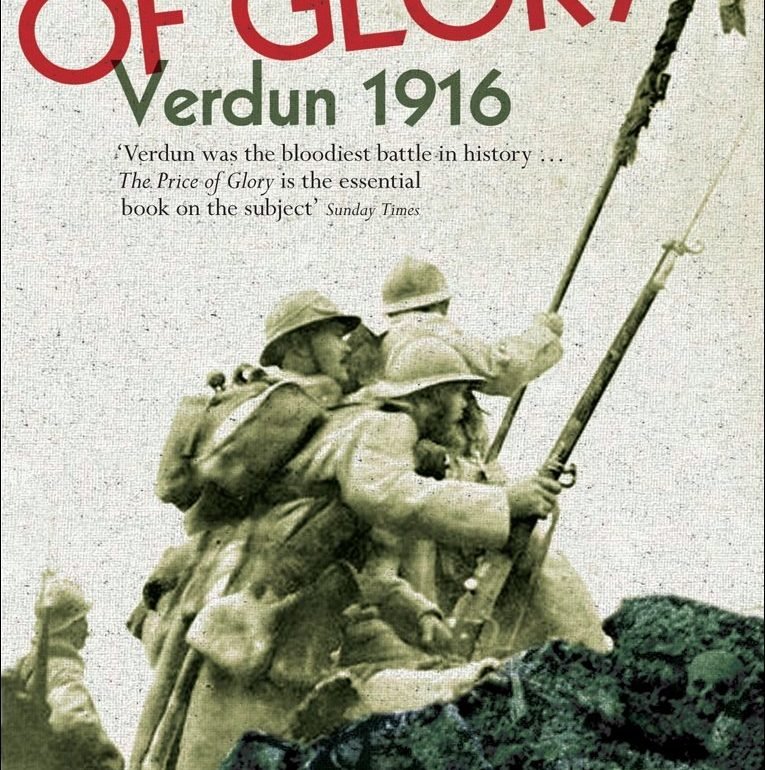
I first read this book in the late 1970’s and I return to it every few years, each time learning more about the battle and being amazed at the ability of men to endure months of slaughter, in the snow and rain, often without food for days, covered in mud, trying to dig themselves deeper in the deep sucking mud in a vain attempt to escape some of the 37,000,000 artillery shells which were fired during the battle. The author puts a face on many of the combatants, using letters and diaries written at the time and long forgotten when their authors were destroyed later in the war. He was also able to interview veterans of both nations as well as widows and children which he mixes in to keep us focused on the humanity of the combatants.
Going further, the author portrays the key military leaders involved in the battle and how some jockeyed for advancement and how a few, such as General Petain, did what he could to save the army while at the same time showing a rare compassion for the lowly Poilu. While German general Erich von Falkenhayn designed the battle to bleed the French army dry using overwhelming fire power, in two instances he hesitated to act which could very well have brought not only victory at Verdun, but also for Germany in the war. In the end, both armies were bled dry but with a war on two fronts for the Germans with a poor ally (like being tethered to a corpse according to the German high command), command failures such as exhibited by von Falkenhayn were simply unacceptable.
Wars are always terrible, unimaginable for most people, but this history brings out not only the tragedy, but the sheer determination of men in war to survive and achieve. Reading this book will always make the reader thank any veteran they meet for what they were willing to do to keep the walls of society safe.