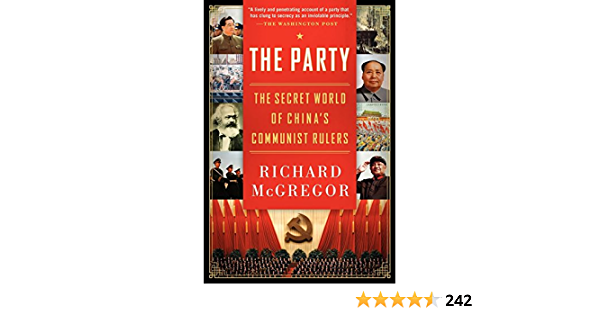
This is a re-read for me and although it was published in 2010, during the tenure of China’s previous leader, it is a book that is more important than ever. Why? Because Xi Jinping has successfully set himself up, for the first time since the death of Mao, as the equal in thought and leadership to Mao.
As with all leaders of China who serve two five-year terms, the second term, unlike a re-elected President in the United States, is not seen as a lame duck, but is entering a time of greater power. The ability during the first five-year term to place hand chosen personnel in key positions of authority (and limited power) is a tactic harkening back to the earlies days of Communism, and is in fact, practiced in business, the academic world, etc. But unlike the other disciplines, in China key policies can be implemented due to the centralized power in the hands of a leader like Xi Jinping. And, by aligning himself with the image of Mao, after purging numerous centers of power (the leadership of Shanghai, numerous military officers, and financial leaders,), he has consolidated his power and authority at a key time.
There is no doubt that China has become a major regional power (militarily and economically) and a major economic power on a worldwide basis. And, as with other powers, there is a time of ascent which provides that power with a unique ability to re-write its place in the world. China has a world view that is based on its long history, it views of its inherent cultural superiority and its desire to right old wrongs from the days of the colonial empires. To fulfill its destiny, other nations in the Pacific area will need to acknowledge China’s superiority and brought to heed one way of the other.
What is plainly pointed out in this excellent book, is that the driving force behind the rise of China is the Communist Party. The centralized control of the party allows it to direct resources and unity of command to sectors which further advantage the main goals of the Party. At the same time, as with all other totalitarian (and Communist China is a totalitarian regime) examples, there is tremendous competition for primacy in the various sectors. This struggle which leads to strong leaders also means that periodic purges must be held when the local factions become too strong or corrupt. These purges allow the Party to show that it is looking out for the average man and allows wrongs to be put upon not the Party, but errant bureaucrats.
One key feature of the Party is that it is above the government, above industry, above the masses. From this height, the Party extends its reach into every key industry, becoming in fact, owners of the industries. When we see security concerns about telecommunications deal with a major Chinese supplier or wonder if the chips which are produced in China and are in our most advanced fighters will function at capacity, it is because the companies themselves are owned and are extensions of the Chinese Communist Party. The control of “key” industries means that all top management serves at the whim of the Party and thus all good things flow from the Party. The Party is willing to allow much of the consumer segment of the economy function in an open manner (unlike the old Soviet system), but the “key” industries are tightly controlled and direct by the Party.
I would recommend this slim book to anyone who is interested in beginning to understand how a modern totalitarian system can operate. The Party has been able to walk the fine line of providing an increasingly better standard of living for hundreds of millions while maintaining its primary place in society. The question remains however, if as with all totalitarian systems, if they can control their natural inclination to find both internal and external enemies on which to focus to divert popular discontent. The purge of “corrupt” officials is one example of how the Party can focus and direct attention. But the attempt by Xi Jinping to equate himself with Mao points to a much more dangerous and challenging future course.