
At the end of World War II, Europe lay destroyed; millions displaced, millions dead, tens of thousands of cities, towns and cities burned out and a manufacturing base almost totally bombed out of existence. During several meetings between Stalin and George C. Marshall, it became clear to Marshall that the Soviets were not going to co-operate with the rebuilding of Europe. The main point of contention centered on Germany; it was Marshall’s belief that Germany was the main economic powerhouse of continental Europe and that it’s resurrection would lead to growth and political stability in Europe. Stalin also realized that, but a strong and productive Europe was not in his best interests; let Europe continue to live in poverty and hunger and the political instability will benefit Stalin.
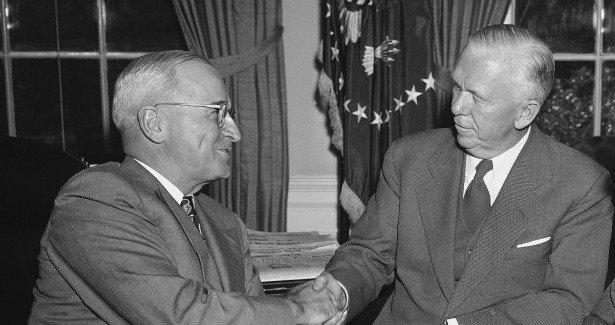
After their last meeting, Marshall knew that it was in the best interest not only of Europe, but also the United States to rebuild Europe. Just seven weeks after his meeting with Stalin, Marshall developed a plan for the rebuilding of Europe and presented it to the President Harry Truman. The thought of spending billions of dollars to rebuild Europe was not popular but President Truman was firmly in favor of the plan. But how to get Congress to go along with the plan? Truman was considered a political hack by many and achieved the office of President only due to the death of the venerated Roosevelt.
Clark Clifford, then a political advisor to the President, recommended that the bill be called the Truman Plan, but Truman replied, “If I send the plan up the hill (with Truman’s name), it will quiver a couple of times, go belly up and die. Even the worst Republican will vote for the plan if Marshall’s name is on it” and so the European Recovery Act became known as the Marshall Plan.
George C. Marshall, also honored as the “Architect of Victory” for his work building the U.S. military both before and during World War II, went on to give an eleven-minute speech at Harvard in front of fifteen thousand which changed the course of history. As predicted by the President, Congress in part because of the great esteem they had for Marshall, appropriated billions for the rebuilding and resurgence of Western Europe. Monies were offered to Eastern European nations but being under the control of the Soviets, they were directed to refuse any monies, as Stalin feared a strong U.S. presence in the captive nations.
The plan was a remarkable success and lead to the West German state, the regrowth of Europe and the economic boom of the United States. In the background, the political realism and concern for actual success stood President Harry Truman. His ego, self-confidence and political savvy was strong enough to ensure the success of a plan that saved Europe. That is a test of a true leader.