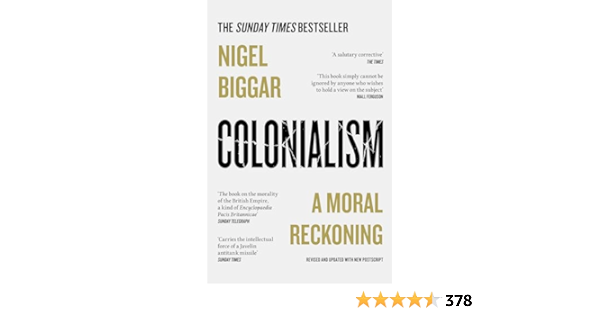
We seem to be living in a time when a goodly portion of humanity, the white portion, should be, according to many on the Left, walking around with ashes on our heads while we practice self-flagellation for the sins which our race has done to most of humanity. This is especially true of the ignorant and those who seek to make a name-and money, from this narrative. Unfortunately for them, there are those who question if these ignorant and self-righteous have any idea about what they are talking about. One such person is Nigel Biggar, the Regius Professor Emeritus of Moral and Pastoral Theology at the University of Oxford. His excellent book, Colonialism: A Moral Reckoning looks openly and honestly at the charges of those who claim that colonialism, specifically that practiced by the British Empire have a grounding in fact. He looks at various questions such as, what was the driving force behind the Empire? Was it greed? Was the Empire basically racist? Was the Empire violent in that it imposed terrible conditions on its colonial subjects?
Although not a professional historian-he holds a BA in Modern History from Oxford while his Ph.Ds. are in Christian Theology and Ethics in Christian Theology and Ethics from the University of Chicago, his knowledge and research is excellent and he brings a balanced view of history as he includes the ethical component which in this case adds more depth to the book.
He initially raises the question of the concept of colonialism in that colonialism is as old as humanity. The empires of the Assyrians over four thousand years ago practiced colonialism. They were followed by the Egyptians, Babylonians, and Persians. The Athenians, Romans, Muslims, Asantes, etc. all were colonial powers. Some brought value with their overlordship, some only brought suffering, so how and where did the British Empire stand in relationship to all those who had gone before them? How did they stand against their contemporaries, such as the French, Russians, Dutch, Moguls, etc.? The problem and challenge are to not only read those who attack colonialism, but to look at their research to see if their writings are based on facts.
One such example is a famous quote which is attributed to Cecil Rhodes, when he is reported to have said, “I prefer land to the n—ers..the natives are like children. They are just emerging from barbarism…one should kill as many n—ers as possible.” A terrible statement, often quoted by eminent historians as an example of the mindset of the British Empire. There is a problem however, for there is no evidence that Rhodes ever made that statement. Much of the statement was written by a former Rhodes scholar who is a director of a major Pan-African university in Johannesburg while more of it was “made up from three different elements drawn from three different sources” including a novel. Hardly scholastic proof. In fact, Rhodes supported the franchise in the Cape Colony that gave blacks the vote on the same term as whites, he funded a black newspaper, and his scholarship was color-blind from the first. Such minor details escape those who use Rhodes as an example of the British mindset.
His book is chapter after chapter of not whitewash, but a review of the times, norms, attitudes, and actions of both the British and the people’s they ruled. He discusses the abuses of colonialism as well as the benefits which provided the locals to better their lives and futures. The Empire stopped abuses such as the burning of widows, instituted a legal system where for the first time, the poorest of the poor could confront those who had previously exercised power as they wished. More rail mileage was built in India than existed in Great Britain with the result that freedom of movement, increased trade and food was more readily available than before their arrival.
And yes, there were abuses. Most abuses came at the local level, by the soldiers, local traders, etc. rather than from the governors, magistrates, and administrators. He quotes the proclamation of governors and provides details on their actual achievements. Those governors who exercised a great deal of freedom in their area seldom abused the great power they had and there are instances quoted when the locals feared a return to the old days where power was used arbitrarily when the governors were withdrawn. There was racism in many instances, especially in India after the Sepoy Rebellion when old loyalties and trusts were torn apart.
Because the author has a background in ethics, he broaches the question of compensation, one which is heard as a drumbeat. On one hand, were the natives justly compensated for their goods and land? Did they suffer to a greater or lesser extent from racism? How many locals were killed when they demanded independence or during times of famine? On the other hand, what was the value of immunization against disease which saved millions of lives? What was the value of freedom from slavery as practiced by local rulers? What was the value of instituting an educational system and the values of that system which allowed the locals to be able to step into power once independence was achieved?
This book may not convince the rabid anti-colonialist that the British empire experience had any positive worth. The author did however achieve one of his goals in that any reader who approaches the subject with even an inkling of an open mind will realize that the pros and cons, the costs vs. benefits, of colonialism as practiced by the British require a serious weighing on the scales of if not justice, at least intellect.