

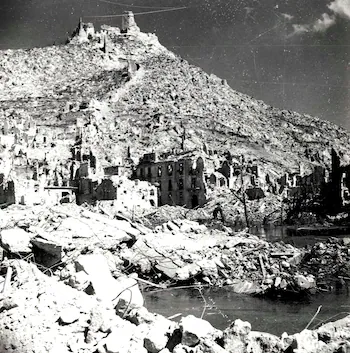
Not as well known in the U.S. as in the U.K., James Holland only became interested in World War II in 1995 when he saw a Spitfire for the first time. Since then, he has written over a dozen books about World War II (mostly about the western European Theater) as well as a good dozen fictional books. I recently saw him give a talk on one of his works and his enthusiasm for the subject was amazing, but not as amazing as his discussions with actual veterans, their diaries and letters and their families that he interviewed for his books. It is clear that he absorbs his firsthand resources and pours them into his books, making each little story an integral part of the whole.
This is the first of Mr. Holland’s books that I have read, and it is a very heavy book; heavy in the sense that the detail is dense and this can be a challenge for the deletant or novice reader. I do believe, however, that it is worth the effort as one comes to understanding the tactical and strategic side of war, not to mention the other forces that drive the commanders and those at the sharp end of the bayonet. Politics, ego, self-satisfaction revenge, anger and fear, are all found in the many personalities noted in this volume. Generals are disappointed and sacked, enlisted men suffer from lack of food, medical care, proper equipment and munitions and sorrow as they are amazed to survive when they see their best friends vaporized by artillery while just a step away. This excellent treatment of a theater of the war which is often neglected gives those who fought their moment of appreciation.
There were several armies that fought in the campaign: American, British, French, Polish and German. Each faced their own challenges, each had their own advantages. The overwhelming material strength of the Allies determined the outcome of the battles as repeatedly the Germans were a battalion short at a key place or were decimated by the Allied air superiority. As usual, the Germans managed to scrape together ad hoc battle groups made up of survivors of multiple divisions or regiments. Those ad hoc groups punched far beyond their class, and they were a tribute to the methods of the Wehrmacht, but in the end, it was the citizen soldier, the men who came from the farms, factories, small shops, etc. who won the day. Not for glory, but because the job had to be done.
One thing that the author does that puts a real seal of approval on this book for me, is his excellent Postscript. In that section, he provides a scholarly and professional analysis of some of the key commanders, pointing out key errors, assumptions, fears, and egos that impacted the battle. An excellent example is his comments on Field Marshal Albert Kesselring who managed to exit the war with a reputation that glossed over his command participation of various war crimes. Often presented as a Luftwaffe officer who managed to successfully transition to a Wehrmacht combat commander. Holland points out numerous tactical errors committed by Kesselring, his deadly adherence to Hitler’s orders to fight for every meter of ground, wrongful obsession with Allied strategic strategy and failure of any strategic strategy. His arguments are convincing and he offers similar comments on Generals Lucas, Clark, and others.
Warning! If you do enjoy this volume, you may be hooked on moving forward with some of this other dozen or so campaign books, but that is an addiction that anyone interested in good history reading will enjoy!



Leave a Comment