

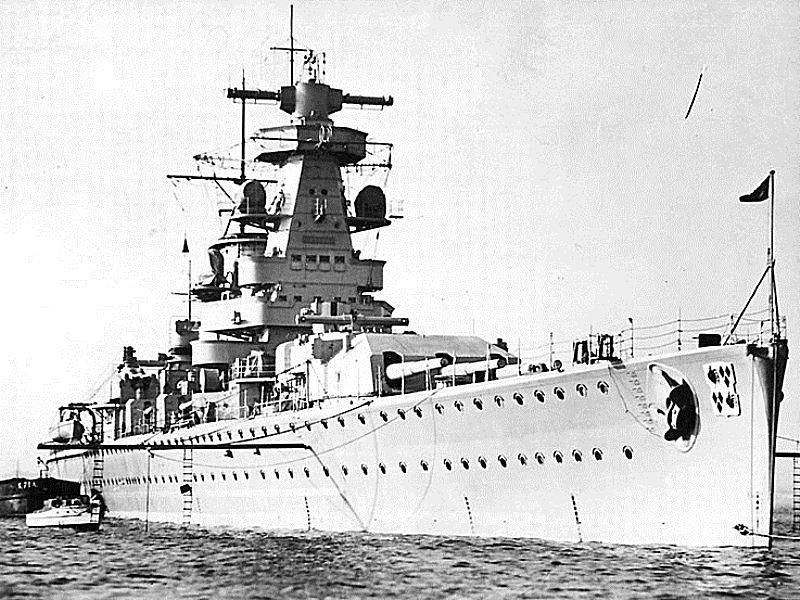
When we think of war, we tend to think of great campaigns, great Generals, and the struggle between nations. The countless small battle actions done by the millions of people who make up the battles are often overlooked. We know no individual combat action by any of those millions will be decisive in the war, but taken together, they create the victory or defeat in war.
The battle of the River Plate, off the coast of Montevideo in mid-December 1939 was a single action that was not a major factor in the loss by Nazi Germany. It was a battle that was more symbolic for the British and a lesson learned by the German Navy. On the surface it was a battle between a German “pocket battleship” and the British navy; one ship against a professional navy that could call on aircraft carriers, battleships, heavy cruisers, and other ships by the dozen. Logically, there was no doubt of the outcome of the battle, yet it had to be fought for war is not a gentleman’s game.
The German ship was the Graf Spee, a lone ship whose main purpose was to seek out and destroy Allied merchant ships in both the Atlantic and even the Indian oceans. The presence of such a ship, armed with six-eleven-inch guns put every merchant ship, destroyer, and light cruiser in harm’s way. If the Graf Spee could not sink any ships, her existence and presence would disrupt the passage of merchant ships and with every ship valuable to the survival of England, she had to be hunted and destroyed.
The author does and excellent job of outlining and following how the British reacted to the realization that the Graf Spee was lose in the Atlantic. They immediately reached out to their major ports to gather ships capable of destroying the German raider and created several hunting groups. From the North Atlantic to the Med to the southern tip of Africa, heavy units of the British navy all joined the hunt for the Graf Spee.
For anyone not familiar with navy ships, the book does leave something to be desired regarding the match up between the Graf Spee and the British; speed, armor, firepower are briefly covered by the assumption seems to be that the reader at least has a glancing knowledge of these topics. Also missing are the stories of the individual sailors for both sides. Anyone who has read the excellent Last Stand of the Tin Can Sailors by James D. Hornfischer will be disappointed at the lack of personal depth in this book.
In the end, the British sank the German raider, the war moved on to the Battle of the Atlantic and one episode in a great war ended. Yet today, it is a tradition when sailing off Montevideo to sail over the graveyard of the Graf Spee and think even if only briefly, of those men who fought and died some eighty-five years ago.






Leave a Comment