

Mao’s Great Famine: The History of China’s Most Devastating Catastrophe, 1958-1962 by Frank Dikotter
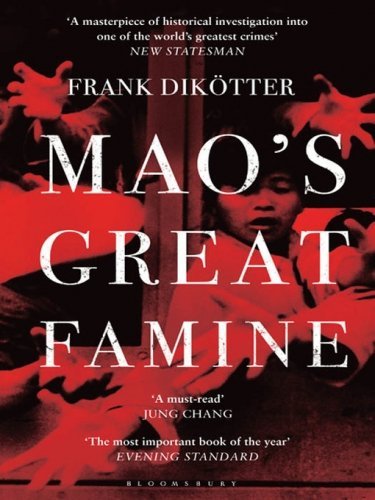
What is the correct number? Thirty-Two million? Thirty-Seven million? Forty million? The correct number of those who died during the period of 1958-1962 as Mao and the Communist Party of China instituted a command economy will never be known. The exact number will never be known because so many people were dying, primarily of starvation but also because of beatings, executions, and torture that records could not be kept. The millions did not die because they were some foreign enemies or, as is the case with the Holocaust because of some racial theory; they died because of government incompetence, bureaucratic lying and ignorance of the basic laws of nature.
What exactly is a “command economy”? The “phrase comes from the German Befehlswirtschaft. It was originally applied to the Nazi economy but was later used to describe the Soviet Union. Instead of allowing dispersed buyers and sellers to determine their own economic activities according to the laws of supply and demand, a higher authority would issue commands determining the overall direction of the economy following a master plan. The command principle entailed that all economic decisions were centralized for the greater good, as the state determined what should be produced, how much should be produced, who produced what and where, how resources should be allocated and what prices should be charged for material, goods, and services. A central plan replaced the market. (Mao’s Great Famine, pp 127).
A “command economy” then is a top-down system by which the leaders provide objectives and quotas for the amount of grain to be produced, how many tons of steel will be produced, what type and how many shoes, socks, shoelaces, etc. will be produced in what time period, etc. Operating in a totalitarian system like Communism, each layer below that top simply takes the quota they are given and adds a little more to please the powers that be. By the time the quotas reach those who produce any given item, the numbers are so large that they are totally unrealistic. Rather than argue against the numbers (and labeled a right-wing reactionary), the producers “fudge” the numbers to meet the quota. And an example is the production of rice, a staple of the economy. If the actual quota is not met, the rice crop is soaked in water to increase the weight as the rice absorbs the water. Amazing, the quota is met! The problem with that technique however is that the rice quickly rots and as the price of rice goes up (inflation), the consumers literally have to sell the clothes off their backs to pay for rotting rice.
Unfortunately, the leadership under Mao did not focus like a laser on their plans and as a result conflicting quotas and projects would be delivered. An example was that while the crops were about to be harvested, all the men would be sent off to build a dam or new road. No matter how hard or quickly the men worked, the result was that most of the crops were left to rot in the field.
Another example was the desire to produce more steel as Mao believed that steel production was an indication of a nation’s strength. Every peasant had to build, outside of their house, a kiln to produce steel. The result was that again, crops were neglected and the quest for fuel led to the stripping of their huts of every bit of wood. Doors, window frames, framing, floors were all fed into the backyard furnaces. Then the trees were cut down. Drives were instituted to collect pots, pans, ax blades, and any metal which could be fed into the furnaces to be turned into what was poor quality ingots which were useless. Then the rains came and the terraces which had been stripped of all trees collapsed and hundreds of thousands died in the floods.
This can be a difficult book to read as page after page of horrors are revealed. Those who had the least paid the greatest price for the vainglory egos of those who directed the nation. Like staff officers in World War 1, the leaders seldom if ever visited the land they ruled as they feasted and made their plans. Cut off from reality, they thought that they had managed to find a solution to common problems that had somehow illuminated the entire human race for thousands of years.
This book has something for everyone, cannibalism, waste, politics, greed, deceit and more. Tens of millions died and the Chinese economy was destroyed. The World Economic Forum has a slogan: You will own nothing, and you will be happy. I am sorry, that idea has already been tried a few times and it did not work out all that well.




Leave a Comment