

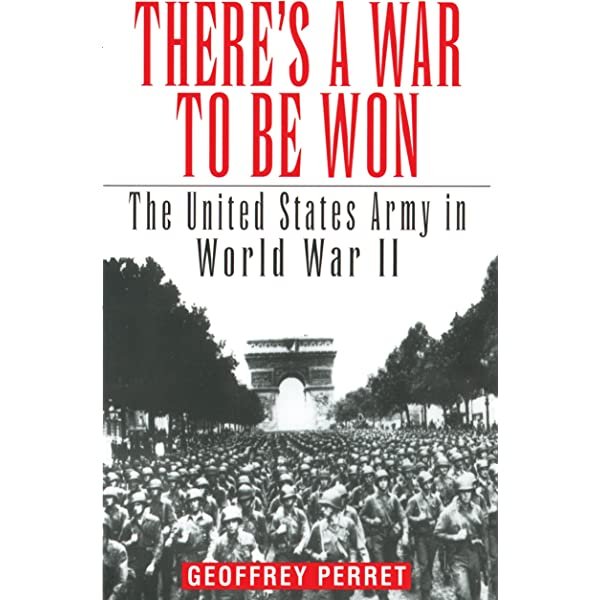
How was it possible for the United States Army, which numbered less than 200,000 men and which was smaller than the army of Portugal, would go on to defeat Nazi Germany, Fascist Italy, and Imperial Japan, while only losing one battle during the Second World War? How was it able to put into the field, armies which managed to beat the hardened professional armies of its enemies? The answer can be found to a large degree in this outstanding book by Geoffrey Perret.
One leader does stand out above all the rest, and it is not the President, Franklin Delanor Roosevelt; it is the man he picked out for the job of creating the U.S. fighting force, George C. Marshall. Marshall was a man who knew how to surround himself with the best of the best, both in the administration of the army and in the field. A tireless worker, he expected the same of those around him and he did not hesitate to demote or retire high ranking officers who failed in their jobs. That type of ruthlessness saved lives and was expected of every officer no matter what his rank. He also realized that the old style of thinking in the military, that of matching the enemies’ weapons, one to one was outdated. Marshall managed to skip a generation of military thought in creating a fighting force that simply was better trained, better educated, more creative and better supplied than any other military of its day. Since the focus of this volume is on the army per se, the author does not delve into the genius of the American industry who overcame so many hurtles to deliver the tanks, ships and planes needed by the military, but he does give many examples of the excellence of what was provided.
While the various campaigns are described vividly and in an excellent manner, many of his best chapters are on specific challenges faced by the military and how they were faced. His chapters on the battles for logistics, the introduction of blacks and women into the military (including blacks into front line service), the question of arming the Japanese Americans whose parents were forced into camps under military guard, and so much more are all covered in a manner that puts the reader right into the debate.
One area of special interest is in the individual G.I. Many of the draftee had served in the Civilian Conservation Corps, so they at experienced a degree of discipline not found in civilian life. For millions however, army life was a staggering experience. Marshall took great pains to ensure that they knew what they were fighting for and against. The famous “Why we Fight” series of films contributed to the men’s understanding of the enemy. And, the U.S. military was the best educated military in the world. To help maintain their morale, daily army newspapers were distributed, medals were awarded more freely, and a special effort was made regarding the delivery of mail to all the troops. Marshall realized that young men, in war, far from home and in life threatening danger, longed to know that those at home thought of them. His efforts were so great that only one U.S. servicemember was executed for desertion during the war (the Soviet Army executed 12,000 of their own men in one battle, Stalingrad, while the Germans executed over 12,000 of their own men for desertion during the war).
Perret manages to put a very human face on the millions who served, and one can find the hand of Marshall in an amazing number of details that created and kept the army as winning force. This is my fourth reading of the book (the first was 1991) and it is as fresh as the first. Unlike other books which have multiple readings, new interpretations and facts may arise, but it is not the case in this excellent work.



Leave a Comment