

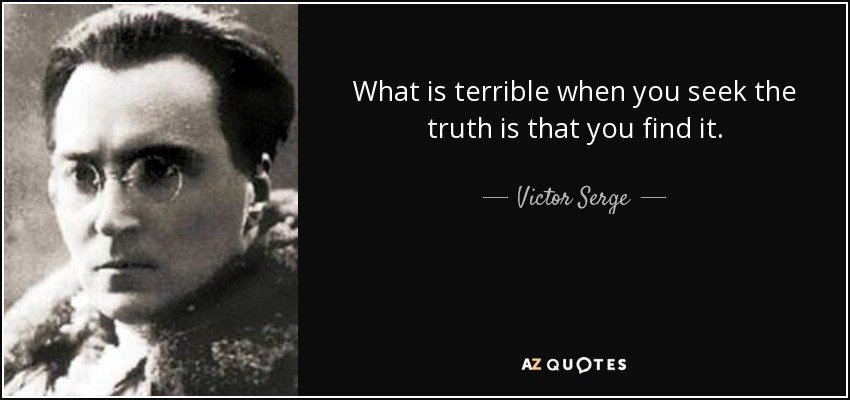
Victor Serge (1890-1947) was born Victor Lvovich Kibalchich to Russian anti-Tsarist exiles and grew up in Brussels where he mingled with socialist, anarchist, unionists, etc. Leaving home while in his teens, he lived in a French mining village and then in Paris. He became an anarchist and editor of a like-minded paper and after refusing to testify against comrades who participated in an anarchist action, was sentenced to five-years in prison.
When released in 1917, he traveled in 1919 to Russia then in the midst of a civil war. From this point on, his description of the Civil War, bloody elimination of factions opposed to the Communists, the excesses of the Cheka, the Kronstadt Rebellion is one of the best descriptions of that period on record. Still an anarchist, he is allowed to edit several papers (until the Communist close them down) and can participate in governmental conferences until the Communists begin to turn on their own. Intra-party fighting pits Left Opportunists against Right Opportunist, Left and Right Deviationist against each other and of course, the anarchists against all the above. Unlike John Reed’s classic (but dry and pro-Party book), Serge gives us a real feeling of the ever-changing forces and factions as the Communists attempt to solidify their hold on the world’s largest country.
Serge is eventually jailed by the Party, but his international reputation protects him from the excesses of the time (beatings, starvation, isolation, etc.) and he manages to have a relatively mild internal exile. He is even released at the end of his term and allowed to travel back to Moscow where again, international support enables him to obtain an exit visa. Getting into the West, he is amazed at the abundance of goods and food available to the humblest person. He believes it proves the victory of Socialism but somehow manages for forget that the abundance is based on the material wealth created by Capitalism. His troubles are not over as local Communist parties create problems for him by telling local police (remember this is during a period in European history where there was a real fear of mass Red uprisings) that he is organizing anarchist cells, hiding weapons, etc. Settling finally in France, he has to flee again when France falls to the Nazis and ends up in Mexico.
Reading this book, one sees the life of a true revolutionary. He tells us little of his personal life (he is married several times, but we know little of what happens to each wife) and you realize that he is the living image of the dedicated revolutionary. An anarchist, he never seems to learn that his goals are unattainable due to human nature. Even after seeing the initial optimism and excitement caused by the Russian Revolution turned to the terrible infighting and brutality between the numerous factions, he still seems to believe that everything “just went wrong” and that the problem is not in his political views, but in the unaccountable and unpredictable nature and ego of mankind.
It is difficult for anyone to admit that a premise of their life was incorrect, that they themselves have created their own problems and that to make life easier, they must change. For a dedicated revolutionary like Serge, I believe it would have been an impossible task. He had to die as he lived, a believer despite reality.





Leave a Comment