

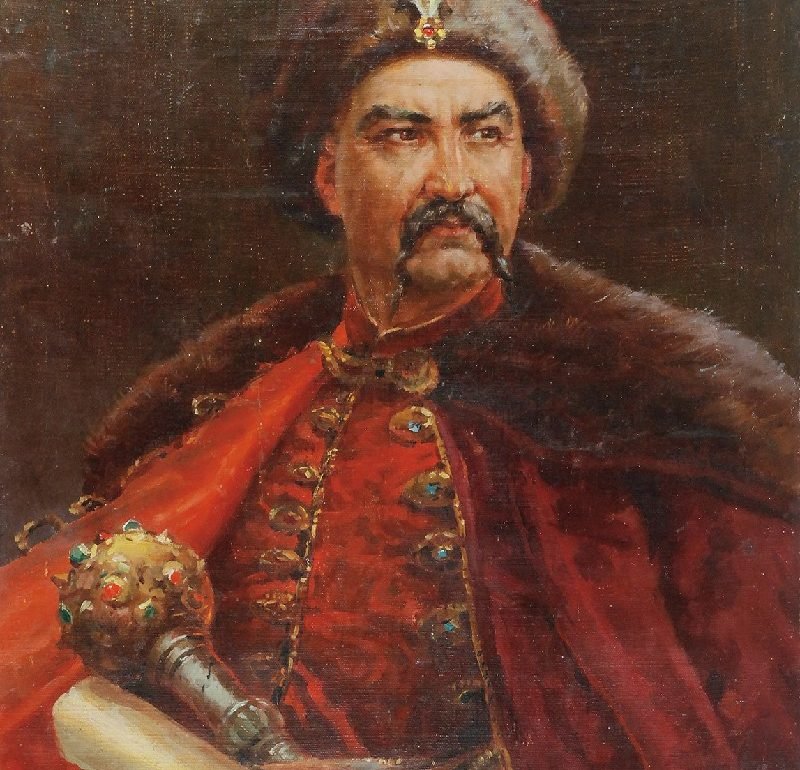
In the mid-seventeenth century in the Polish Commonwealth (at that time the largest nation in Europe), a terrible war broke out between the Cossacks let by Bohdan Chmielnicki (a national hero of the Ukraine) and the Poles. The Cossacks, long time allies of the Poles in battles against the forces of Islam had become alienated from the Poles due in part to the actions of the great Polish magnates, the differences in religion (Catholics vs. Orthodox), the Cossacks and Ukrainian view of being exploited by the Jews brought in by the magnates and a lack of opportunity for plunder by the peace between the Commonwealth and Islam.
The ensuing war lasted about nine years during which much of the Ukraine, parts of Poland and Lithuania were laid to waste as hundreds of thousands were killed in battles, sieges, and local slaughter. Invited into the Ukraine by the Cossacks, both Tartars and Turks rampaged across the land and took so many prisoners that the slave prices in the Crimea and Constantinople were drastically lowered.
This book using contemporary and later sources attempts to put the war in perspective from the memories of the Poles, Cossacks, Jews, and some Ukrainian sources. Each narrative has its own viewpoints, and each tries to blame others for the terrible time and events. One thing which stands out is that in Jewish history, is that until the Nazi directed holocaust, those times were considered as the greatest tragedy in “modern” Jewish history. Although exact numbers are not available, estimates vary from 100,000 to 500,000 Jews murdered with a number of sources agreeing on 2-300,000.
The war is sometimes called a civil war due to the former close relationship between the Poles and Cossacks. The Ukrainian natives of the area were despised by the Cossacks and abused by the Poles, yet the hatred of the Ukrainians for both Poles and Jews led them to support Chmielnicki even as they were, after slaughtering any Poles or Jews in support of the Cossacks, then murdered or enslaved by the forces of Islam.
Why were the Jews so hated? The Polish magnates who owned huge expanses of land, spent much of their time in Warsaw or traveling throughout Europe, so the management of many estates was given over to Jews brought in by the magnates. Over time, abuses against the locals multiplied as the Jews functioned as tax collectors, they ran much of the trade (stores, bars, etc.) and were accused of even making the Orthodox pay to get the keys of their churches so they could attend mass. Yet, it is clear that many of the supposed abuses were only mentioned in history written decades after the actual events. How much was true and how much a rationalization? What is clear is that having customs and a language different from the locals, the gap between the cultures only grew wider and the war was a reason for revenge against real or imagined injustices.
This is a complex book, not one for a casual read. The tales of cruelty, torture and rationalization by all sides can make the reading difficult. Since there were few histories written at the time, many sources are traced back to Polish academics who argued all sides as late as the late 1890’s.
Chmielnicki was a man driven by hate and fear (a son of his was flogged to death on the order of a Polish magnate while he feared that the Tartars and Turks would turn on the Cossacks and destroy them). He brought slaughter to the Ukraine, despised the natives and yet is seen today as a hero of Ukrainian nationhood. The book shows that history can be used and distorted for any convenient purpose.



Leave a Comment