

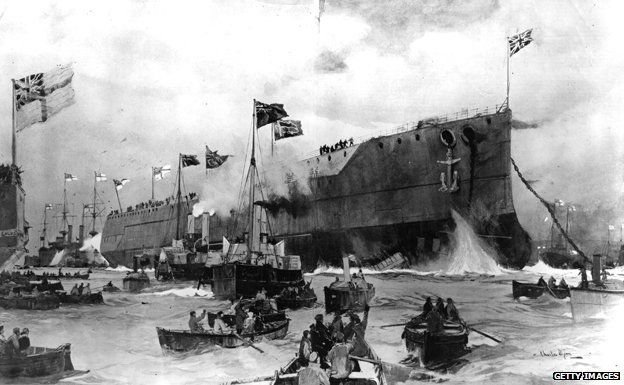
These two books total about sixteen hundred pages and place the reader inside the offices of government for the U.K. and Imperial Germany from about 1906 to the end of the First World War. It was during this time that the great arms race in Europe occurred, and it was accelerated by the creation of the German High Seas Fleet. Germany, a late comer to the race for colonies, had no real fleet except a few coastal defense ships under the first Kaiser. His son, Kaiser Wilhelm II however, fell under the influence of Alfred von Tirpitz who pointed out that the safety and benefit of the few German colonies existed at the discretion of the British Navy. With that realization and an excellent public relations campaign by pro-navy individuals and businesses, the great naval race began.
What made the race seem winnable to the Germans was the introduction of H.M.S Dreadnought, the first all big gun battleship for Britain. Before Dreadnought, battleships carried a range of larger guns, for example, four-eleven inch and four-eight-inch guns. The problem with such an arrangement, however, was one of the sightings of where shells hit and the targeting as the guns had different range characteristics. H.M.S Dreadnought however, carried ten-twelve-inch guns, plus more armor as well as being faster than any previous ship of its class. It also did away with coal as its source of power which meant that the British “coaling stations” across the world needed to be updated. Thus, it was that every pre-Dreadnought battleship became obsolete, and Britain had the world’s largest battleship fleet. Was there an opportunity for Germany or any other power to become the new equal of the British navy? The naval race was on!
As the years went by, further refinements were found for the new class of battleships. What was the “right” balance between firepower, speed, and armor? With the British determined that their navy was to be stronger than the next two navies combined, new classes of battleships were produced, each fitted with more armor, larger guns, greater length for speed, which meant more armor which meant more need for power, etc.
Aside from the wealth of technical information in the books, we see the brilliance, foolishness, meanness, foibles, etc. of the men who ruled or governed Britain and Germany. Many of these men are long forgotten, but many are still recognized to this day. Men like John “Jackie” Fisher, the architect of the Dreadnought (who once told a subordinate, “ I shall make your wife a widow, your children orphans and you house a pile of dung”), Admiral David Beatty, the playboy who married the daughter of Chicago millionaire Marshall Field (who said during the Battle of Jutland as three of his battlecruisers were sunk, “There seems to be something wrong with our ships today”), the Kaiser, and others. Each contributed to the naval race, each made errors, some were brilliant.
How many years it took Massie to write these two books and how he was able pull all the strings of history together is simply amazing. I am sure that they were written in sections as there are times when he repeats himself, but it is understandable that he did not remember every line he was writing. The interplay of all the characters is excellent and the reader will come away with a better understanding of everyday politics at every level. This was my second reading of these books, the last was about fourteen years ago, but they are still fresh and free of historical corrections since they have been written. These are not light reading and some of the personalities can be if not boring, uninteresting, but others stand out as true statesmen and visionaries. They are a vital part of anyone who wishes to understand the causes of the First World war.






Leave a Comment