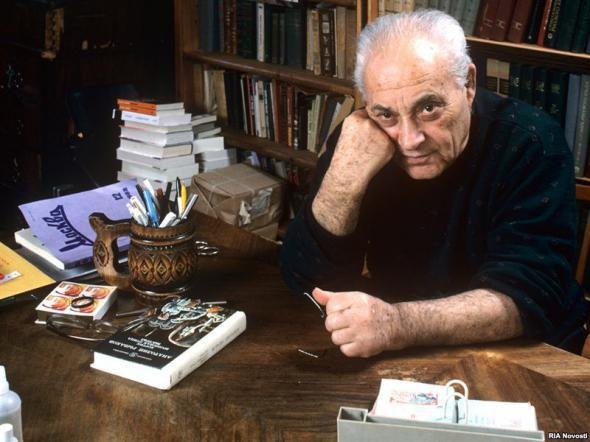
About once every decade I treat myself to Anatoli Rybakov’s wonderful trilogy (Children of the Arbat, Fear and Dust and Ashes). Rybakov himself, like his main character, Sasha, was arrested in 1933 and sent to Siberia for three years. That was before the main Stalinist terror and purges which only a couple of short years later would have merited a term of ten or twenty years. After his release, he was barred from most major cities as his internal passport showed that he had been convicted of a crime against the state. Working odd jobs, he was called up into the army after the German invasion of 1941and was twice decorated. After the war, he continued to write but it was not until Gorbachev and glasnost that the first of his trilogy was published at which time, he won international fame. He continued to write until his death in December 1999 at the age of eighty-seven.
The trilogy traces some of the idealistic youth of the early 1930s in the Soviet Union, as they hoped for a better future. Most were members of the Soviet youth movement, the Komsomol which served as a propaganda arm of the Party, aimed at molding strong Soviet citizens. The book traces the lives of various members, such as Sasha who was convicted of anti-Soviet propaganda when his poster at school was deemed to mock various Party members at his school. Some students keep their belief in the Party, one becomes a member of the NKVD and manages to survive the great purge of the secret police while another is thrown into poverty when her high Party ranking father is arrested in the middle of the night.
We are given an inside view of the time when the purges swallowed large numbers of professors, Party members, technicians, military offices, and ordinary citizens. To fulfill the quotas for arrests sent to local NKVD (Soviet secret police) branches, some officers simply decided to arrest everyone in a certain street or neighborhood on the grounds that it was better to overfulfill the quotas and grind the innocent than to not fulfill the quotas. Comrades of Lenin are put on public trial and confess to working for German, Polish or Japanese organizations aimed at overthrowing the Soviet system. No one asks, “how is it possible for the makers of the Revolution, Lenin’s own compatriots have survived in the Soviet system, at the highest level for so long?” Convicted of the most outrageous actions and acts of terrorism, they are all executed and yet the purges go on and on.
Aside from the general story, Rybakov provides an outstanding psychological analysis of Stalin himself. Moody, distrustful, paranoid, and brutal, we are taken into Stalin’s office and mind as he plots the removal of his “enemies;” in his own twisted world, in which only Stalin was correct, he justifies his actions as he strives to build not only a strong State, but an aura about himself where everyone must acknowledge his genius. When against his prediction, Hitler invades the Soviet Union, Stalin is personally offended that history is not turning out as he predicted. A personal insult!
Although this is a novel, I recommend it to anyone who would like to understand life in the Soviet Union from about 1933 on into the great Patriotic War. The twisted legal system, the most “liberal” Constitution in the world (which was used to imprison and murder millions Soviet citizens), are better understood as one is sucked into a world where there is no logic, no shelter, no safety. It was a world of political correctness where an accidental verbal slip, a failure at one’s work, a lack of enthusiasm at the proper moment could lead to ten or twenty years of misery not only for oneself, but for one’s friends and family. A completely arbitrary world.


Leave a Comment