

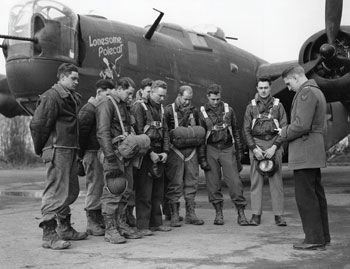
During the Second World War, Allied bombing was responsible for over 500,000 deaths in Europe. The bombing was one part of a war to defeat Nazi Germany and is little appreciated for its impact on the course of the war. Stalin constantly wanted a second front to help his war, and little understood how the air war contributed to his ability to defeat the Nazi war machine. As usual, Richard Overy has provided us with the one book we would recommend for anyone to understand the Allied air war.
Throughout the war, the strategies and tactics use by the United Kingdom and the United States were never really in sync. The Americans coming into the war created a managerial attitude based on their business experience as to what to bomb, how to schedule, etc., while the British who had suffered under the German air offensive built their strategy on what they had learn from being bombed. For example, the British examined the German cities and based on the construction of the houses and factories, developed bomb loads that would cause the most damage. What was the correct mixture of high explosives to incendiary bombs given that their tactic was not strategic bombing, but rather area bombing? It should be noted that often only about 3% of the bombs landed within a mile of their target. Drop enough bombs and something is bound to be hit. The Americans on the other hand with their belief in superior technology, especially the Nordon bombsite, chose their targets based on specific damage of a specific sector of the German war economy. The result was massive raids of one-thousand planes that would go on for days against a specific city, day, and night.
Germany had developed a highly sophisticated system to deal with bombing and initially it served them well. One of the major problems was that the Luftwaffe was not designed as a defensive weapon and the Luftwaffe leadership seemed to be at a loss as to how to cope with the new challenge. Although the Wehrmacht generals blamed Reichsmarshal Goring and Hitler, it was Hitler who insisted that manufacturing focus on fighters, that industry disperse to underground sites, bullied the Luftwaffe into improved electronic warfare and favored a heavy antiaircraft defense. In the end, the German defense required nearly one-million civilians, many of whom could have been used in other war work, as well as twenty-five to fifty percent of all ammunition, electronics, and optical equipment, all badly needed for the land battles. Over four thousand new guns a month were needed just for the anti-aircraft defenses.
One other factor that played a major part in the air war was the weather. Today we think of solar energy, but the reality of northern European weather tells a very different story. In late 1942, the average number of days which were clear was one to two during the winter and only thirty-one for the entire year. Low cloud and fog hid the targets and made pinpoint bombing almost impossible. In fact, with thousands of planes ready to fly, the potential effort was only reached about 55% of the time.
I highly recommend this book to anyone interested in the development of bombing during the war as well as the options for defense. The size of the effort for victory was huge and all credit to those men who spent years doing a job which seems to have been all but forgotten. Average men doing extraordinary deeds.





Leave a Comment