

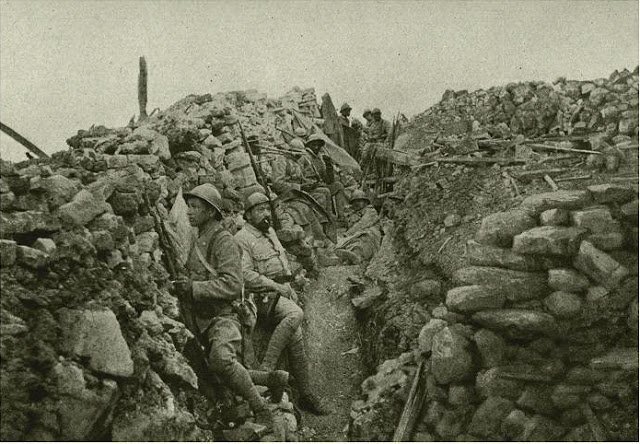
In World War One, the Italian and Hapsburg forces fought a grueling war in the Southern Alps of Northern Italy. Fighting was year-round, with the troops having to charge and fight in deep snow and across raging rivers with few chances for leave or rest. The battles continued for nearly three years and cost both sides about 500,000 killed and many more maimed for life. In the end, the battles were in vain for the Italians, as at the Paris peace talks in 1919, the French and British reneged on their pledges which enticed the Italians to enter the war. The American President, Wilson stood aside and felt that to honor the pledges would be to disgrace his 14 Point Program.
This excellent little book (which was the basis for the Italian film, Many Wars Ago), at points seems to be an Italian version of Catch-22; was the author concocting examples of military idiocy or was the Italian army really that poorly led and equipped? Unfortunately, those parts which seem to be the most absurd are likely completely accurate. The idea that one would create suits of armor for infantrymen and then have them walk toward the enemy lines in full daylight and expect the bullets to bounce off the armor is simply crazy to anyone who has any experience with firearms. Yet, that is exactly what one general did to his men, not once, but twice. But, as the General said, they died for Italy.
The author served in the Sassari Brigade during the war and was decorated for valor several times. The Brigade was drawn from the peasants of Sardinia and was noted for its bravery. After the war, Lussu was involved in anti-Fascist politics and was briefly held in the prison on the island of Lipari for shooting a Blackshirt. In 1929, he escaped and lived in Paris, Switzerland, fought against Franco in Spain and returned to Italy in 1943 to join the partisans. He served as a cabinet minister from 1945-47 and in 1945 this book was published in Italy, where it has never gone out of print.
This is a fine read, written by an intelligent observer of mankind who was respected by his troops. It shows the futility of the war and the honest feelings of the men who had little to gain from the war. An excellent read.


Leave a Comment