

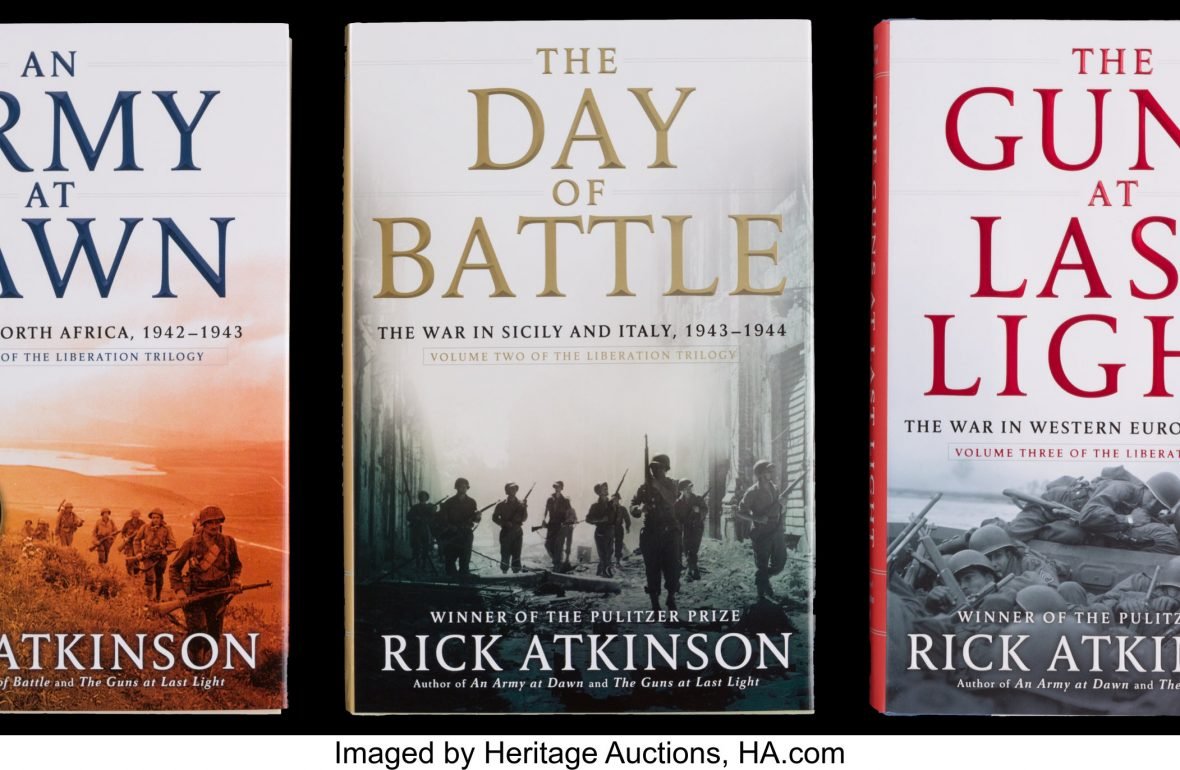
This massive (about 2,000 words) trilogy (An Army at Dawn, The Day of Battle and The Guns at Last Light) detailing the U.S. led coalition which fought in North Africa, Italy, and Western Europe to help defeat Hitler. It offers not only a strategic view of the war, but many interesting human stories of the men who both led and did the actual fighting. They certainly are not all saints; all the human emotions are evident in the telling, including arrogance, lust for glory, stupidity, cruelty, humanity, and anger. Despite the length of each book (and their weight), they are easy to read and difficult to put down, even for a reader with knowledge of the subject.
Given the distance in time from the events, the author provides excellent insights into the personalities of the major leaders of the campaigns. He readily cites other historians’ views as to the personalities of leaders such as Montgomery, Eisenhower, etc., as well as referencing many of their diaries which were written at the time. It is clear that, despite their failures until the arrival of the Americans, the British High Command had a dismal view of U.S. leadership from Marshall on down the line, while the Americans were often like young stallions, eager to show the Brits how to quickly win a war. After the disaster at Kasserine Pass, the Americans began to realize just how much they had to learn, but they were saved by a divided German command system and the vast material wealth which would go on to smother their opponents in the future campaigns.
After reading each volume, one comes away with some simple questions, such as:
- An Army at Dawn (North Africa): How did we ever manage to with the war, given the poor training, often the inferior weapons, poor system of communications, sloppy logistics, etc.
- The Day of Battle (Italy): Why were so many men and so much material wasted in a campaign that no one seemed to firmly handle? Given the nature of the terrain and the superior mobility of the Allies, wasn’t there a better way to tie down German divisions at a smaller cost?
- An Army at Dawn (Western Europe): How could the Allies not have won given the advantage in the intelligence service (specifically Ultra), overwhelming air superiority, etc. In fact, it seemed the greatest danger to the victory was the poor understanding of logistics (by Montgomery regarding the Scheldt estuary), and political infighting (again Montgomery but also the Free French).
The answer I believe lies in two main areas:
- The sheer, overwhelming material superiority of the Allies; the average daily supply needs for every Allied soldier on the Continent was, “33.3 pounds of gas, oil, grease and aircraft fuel; 8 pounds of ammunition, including aerial bombs; 7.3 pounds of engineer construction material; 7.2 pounds of rations, etc., etc.) all of which had to be produced, shipped, sorted and delivered day in and day out throughout the campaign. Every month, the U.S. Army had to replace over 35,000 small arms, 700 mortars, 500 tanks, etc… The list goes on and on. Another example (from another book) is that the U.S. soldiers went to war with 4,000 pounds of logistics to back him up while his Japanese counterpart had only 4 pounds to back him.
- The ability of the U.S. civilian soldier to quickly learn to hate and kill. This was a major concern for many high-ranking officers; they recognized that the German soldier had probably spend several years in organizations like the Hitler Youth and had faced years of combat in Poland, France, Russia, etc… To counter that degree of professionalism, the average American had to experience the sheer brutality of war close up and learn to hate his foe. The measure of that experience is shown in the number of prisoners “shot while attempting to escape” and the acts of destruction by many American troops as they entered Germany. The war had brutalized many men and yet after the war, those same men went on to lead quiet, productive, and kind lives as civilians.
This trilogy would be the one I would recommend to anyone wishing to learn about the Allied war in that theater of operations. There are some other excellent books which give more information on the logistical strengths of the U.S., but this trilogy provides the best view of the war, from the Allied side, from top to the lowly lonely soul in the foxhole.




Leave a Comment