

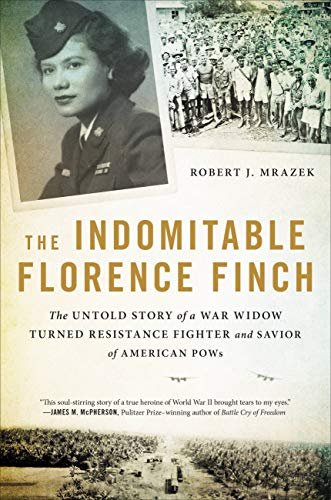
Histories of war are often told from the viewpoint of grand strategies, major military or political leaders or combat personnel. Seldom do we get a view of the war from the ground level as experienced by non-combatants; we somehow seem to believe that their lives go on with a feel of normality, even in occupied territories. In this book we find how a woman, living in an occupied land managed to not only lead a life, but to defy the occupiers and at great risk to herself, feed prisoners of war while at the same time hurting the occupiers war effort.
Florence Finch father was a U.S. serviceman while her mother was of Filipina stock. Raised in a solid household, she fell in love with another serviceman, married him and then was separated by him due to the Japanese invasion of the Philippines. The Japanese occupation of any land was brutal, and locals were only appreciated if they could contribute to the war effort. Not wishing to be branded a collaborator, but needing work, Florence secured a job in a Japanese ministry which controlled the distribution of fuel in the country.
Missing her husband who she assumed was captured and seeing the poor condition of the POWs, she developed a plan to siphon off and sell on the black market, first hundreds, then thousands of gallons of fuel from Japanese distribution centers and use the funds to smuggle food and medicine into the POW camps. She, and those who worked with her were in constant danger of exposure, arrest, torture, and execution, yet the desire to help the POWs drove her and those who worked with her to ever greater efforts and risks.
Eventually she was arrested and tortured by the Japanese secret police, the dreaded Kempeitai. Subjected to months of torture and a starvation diet, she managed to survive and was rescued by the advancing U.S. forces. As her husband had died, she decided to continue her war work and graduated from the U.S. Coast Guard Academy in July of 1945. Recognized for her war work, the crippling of the Japanese war effort in the Philippines and the saving of lives through her smuggling of food and medicines, she was the first and only SPAR (Coast Guard Women’s Reserve) to receive the Asiatic-Pacific ribbon.
For anyone with the smallest knowledge of Japan’s occupation policies, her story will be appreciated for the great deal of courage she exhibited under the direst conditions. Her bravery should make every reader think of what they could do under similar conditions.

Leave a Comment