

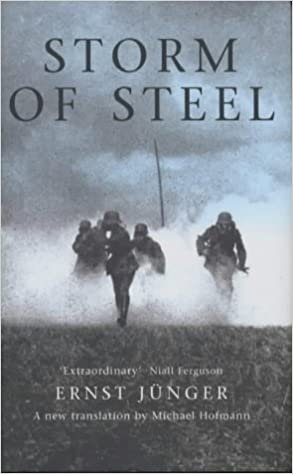
When the introduction of a book describes the author as “nearly as good a specimen as ever worshiped Mars”, you know you are in for a book which not only describes the day to day life in the trenches of World War I, but also a perspective from a warrior who went on to symbolize the ideal for the inter-war philosophy of the “heroic struggle” which so motivated many of the youth of Germany after the war and led to the rise of Nazism.
Junger was nineteen when he joined the Imperial German army and progressed to the rank of captain while winning Imperial Germany’s highest award, the Pour le Merite (equivalent to the Congressional Medal of Honor). After writing this book, Junger went on to a distinguished career which included dozens of books (at one time 47 of his books were translated and being sold in France). Between the wars, he was a “radical nationalist”, opposed to the Weimar Republic and was seen as the arch-type front line soldier. Courted by the Nazis, he refused several honors by them and did serve as a captain during World War II. He fell afoul of the regime but after the war, he was not able to be published for four years until cleared of any involvement with the Nazi party and was widely supported by literary figures around the world.
A well-educated, prolific writer, his later books are often difficult to read (to get an overview of his thoughts through 1945 read Nevin’s book Ernst Junger and Germany, into the Abyss 1914-45), but his book, has many moving passages such as:
“Even modern battle has its great moments. One hears it said very often and very mistakenly that the infantry battle has degenerated to an uninteresting butcher. On the contrary, today more than ever it is the indiv-idual that counts. Everyone knows that who has seen them in their own realm, these princes of the trenches, with their hard, set faces, brave to madness, tough and agile to leap forward or back, with keen, bloodthirsty nerves, who no dispatch ever mentions. Trench warfare is the bloodiest,wildest, and most brutal of all warfare, yet it too has had its men, men whom the call of the hour has raised up, unknown, foolhardy fighters. Of all the nerve-racking moments of war none is so formidable as the meeting of two storm-troop leaders between the narrow walls of the trench.There is no retreat and no mercy then. Blood sounds in the shrill cry that is wrung like a nightmare from the breast.”
He survived twenty wounds during World War I and died at the age of 102 in 1998.
This is a fascinating history of the trenches seen from within the trenches, one which will pull you into the fear, anger and madness that gripped this warrior. Is it worth reading? This my third read of the book.





Leave a Comment