
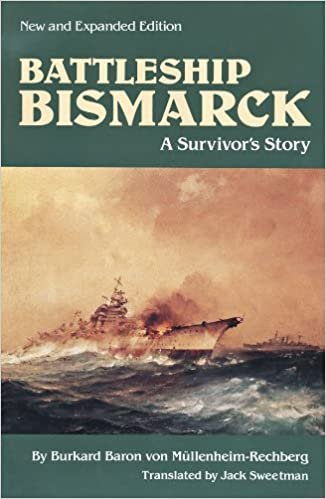
For a week in late May 1941, the eyes and attention of the British Admiralty and the German Kriegsmarine were focused on the North Sea as the German battleship Bismarck, was attempting to break out on a raiding mission in the Atlantic. After sinking the pride of the British nave, HMS Hood, Bismarck turned its attention of the Prince of Wales and swiftly caused such damage that the British ship had to run for its life. Unfortunately for the Bismarck, she was also hit and was badly leaking oil and taking on water. What followed for the next three days has been the subject of books and movies for over fifty years. The author was a gunnery officer on the Bismarck and was one of 115 survivors (out of a crew of 2,200). His story is a firsthand description from “the other side” about a battle that was almost preordained-in my opinion- to failure.
Why would anyone believe that the battle was pre-ordained to failure? Let’s look at some of the problems and errors on the part of the Germans:
- An untested and green crew: Germany had never been a recognized great sea power-despite the naval build up of the late Imperial navy. The crew of the Bismarck consisted mostly of young enlisted men whose naval skills were not as finely tuned as their adversaries.
- The odds: Even after sinking the Hood, it was one German battleship against two British battleships, on battle cruise, one aircraft carrier, half a dozen heavy cruisers and destroyers in the North Sea. Further out, from Gibraltar was another battle cruise and carrier, plus assorted smaller warships. Further to the West was two more British battleships, etc. Every day would bring the British ships closer to each other until there would be an overwhelming fire power against the solitary Bismarck.
- Poor co-ordination between the Kriegsmarine and the Luftwaffe: As was the case throughout much of the war, to a much larger degree than among the Allies, the German military did a poor job of inter-arm communication and support. The lack of air support which kept the Bismarck “blind” beyond the length of their radar while the British used their carrier and cruisers to shadow the Bismarck. Additionally, one would have thought that there might have been support from the U-boat command both in scouting and being near the Bismarck when it engaged with the British.
- Split Command: The Bismarck had not only a captain, but also an Admiral on board which led to a conflict of strategy and goals. In the end, it appears that the two top officers communicated very little and differed on what was the purpose of the cruise.
It is amazing that the author was able to survive after heavy caliber naval guns shattered the Bismarck at almost point-blank range. After the battle, the British managed to rescue a few crew members but they then turned away due to fears of the non-existent U-boats. Moving from various POW camps in the U.K. and Canada, the author used his time in captivity wisely, taking courses and steering away from the many highly politicized naval officers. His time in POW camps was almost a collegial experience and served him well after the war.
This is a story of waste, more so than the normal war story, for while powerful, the Bismarck was doomed to a solitary existence in a world where her enemies would become increasingly more powerful. If it was not this battle, then the next one would have sealed the ships fate. For the inexperienced crew, the death by naval gunfire, explosions, burns, and shock was the only outcome they could expect. It is another example of as one historian once said, “good blood gone in a poor service”.