
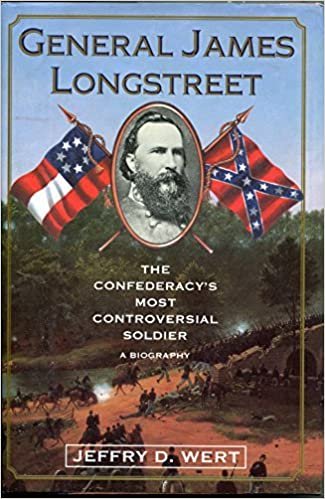
General Longstreet served as Robert E. Lee’s solid right hand, commanding the First Corps. of the Confederate Army during most of the Civil war. A strong believer in states rights (but not necessarily slavery) before the war, afterwards he was a strong Republican, believing that having been defeated during the war, the Southern states needed to work to be fully accepted back into the Union. His post war political beliefs earned him the scorn of many Southerners, especially the old ruling class which hoped (and succeed) to place themselves back in power.
A brilliant tactician, Longstreet advised Lee throughout the war, and Lee often listened. Unfortunately, Lee did not heed Longstreet’s advise at two critical phases of the battle at Gettysburg; Longstreet’s desire to circle and turn the Union’s left and his advice to withdraw and not commit Pickett’s division to an attack on the Union center. Lee admitted afterwards that he should have listened to Longstreet’s counsel. Despite his loyal service to Lee, after the war, when the cult of the personality for Lee grew, Longstreet was blamed for the failure of the Gettysburg campaign.
The one-time Longstreet was more independent was the Tennessee campaign in which he showed tactical innovation during the battle of Chickamauga which lead to a Confederate victory. During the rest of the campaign, he showed slowness however, as if the full realization of the responsibility was too much for him. Clear thinking as a subordinate does not always lead to fearless action as a leader.
Loved by his own troops, known for his fearlessness in battle, Longstreet was the best tactician of the Confederate Army and helped to temper Lee at key times. His second wife outlived him by over 50-years, and she spent them trying to burnish the image and memory of her husband.
I would recommend this book to anyone looking to gain a better insight into the politics and tactics below the ultimate command level.