

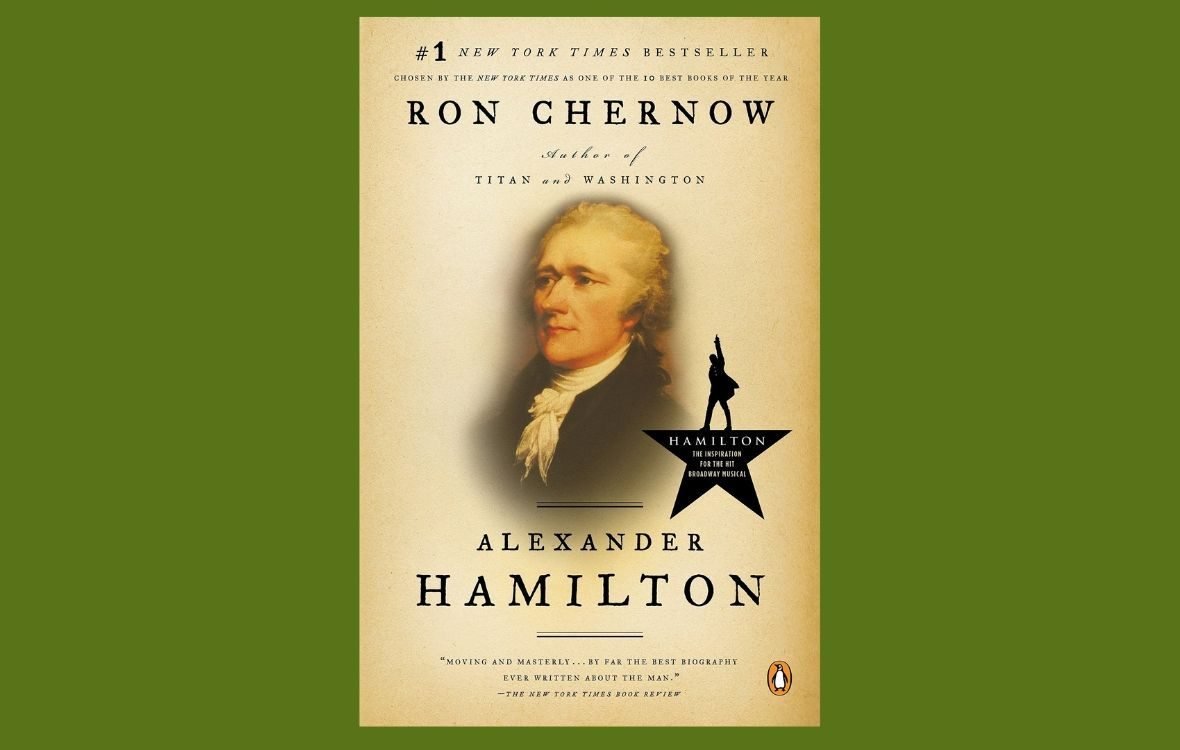
At over seven hundred pages, I approached this book with a certain degree of trepidation; am I really that interested in Hamilton and what about his life could hold my interest. Within a few pages, Chernow snagged me by bringing a man I knew little of into my life and presenting an exciting brilliant personality that fundamentally changed the course of history.
Alexander Hamilton was of common birth; in fact, his birth was outside of wedlock when such things counted for a great deal. Raised in poverty, devoid of parents and a stable home, his intelligence was recognized by those around him and was provided the opportunity to leave his native land of St. Croix to study in New York. At a time when universities were accepting students as young as thirteen (Aaron Burr graduated at 16 from Princeton), Hamilton was viewed as an “old man” of nineteen by his classmates. Yet despite a poor basic education and a late start, his ability to write and debate quickly made him a leader at King’s College (later Columbia) which was a hot bed of pro-Tory support. This put Hamilton as a minority at the school as he was in favor of a break from England, yet his brilliance was widely respected during that time of troubles.
During the Revolutionary War he served on Washington’s staff but after the war, he viewed the Article of Confederation as a flawed document as the country was saddled with huge debts, had no international credit and each of the states ignored the weak central government. Taking an active part in politics, Hamilton managed to drive through the Assumption Act (by which each state’s war debt was consolidated into one central national debt) and was a driving force behind the Virginia Plan. This plan was originally sold as a convention to “amend” the Articles of Confederation but, it turned into a completely new Constitution with a stronger central government and powerful Executive Branch. For the new Constitution to pass, 9 of the 13 states had to approve it. Major objections included a fear that the Executive Branch would echo the very excesses which caused the Revolution, that it would evolve into a Monarchy. To move the approval of the Constitution forward, the Federalist Papers were created, mostly by Hamilton and Madison. At this time, Hamilton was in his late 20’s and was responsible for most of the Papers. Springing literally from his mind, he Federalist Papers created the blue print for our Constitution and was a major leap in political thought. There had never been a document like it before as it outlined the pros and cons of every concept of government.
After approval, Hamilton served as Secretary of the Treasury. Like the Presidency and the rest of the new government, there was not outline of how to move forward. Hamilton quickly moved to set up an efficient tax system, accounting, tracking of assets, etc. and was also involved in matter which the Secretary of State (Jefferson) should have handled but did not due to his dislike of having to deal with people. Additionally, he developed such concepts as “implied powers”, the “necessary and proper” clause, the “general welfare” clause and the “commerce” clause, all of which solidified the supremacy of the central government. These were all opposed by Jefferson, Monroe and Madison.
Hamilton served Washington loyally for both terms and retired to practice law in New York. Now recognized head of the “Federalist”-those who favored a strong central government-he was opposed by Jefferson and his minions (including Monroe and Madison who had disclaimed his views he outlined in the Federalist Papers, he ran afoul of John Adams. That was not especially difficult to do as Adams was an insecure individual who felt unappreciated for his service to the Revolution.
After Jefferson became President (the “Republicans would govern for the next 20 or 24 years), Hamilton began to lose political power due to the fears of centralize political power (why was the Revolution fought?), and a personal scandal of a sexual nature. He remained a successful attorney with a solid practice as well as a powerful political writer. It was during this time that Aaron Burr began to believe that Hamilton was behind Burr’s political fall and it was from this that the famous duel originated. Hamilton went into the duel pledging to not fire at Burr while Burr, after the duel, admitted that he was determined to kill Hamilton, which he did.
Hamilton was a complex personality; a brilliant planner and executive, he owed much to his friend Washington who helped him channel his energies. Without Hamilton at the Treasury, it is doubtful if the United States could have survived if for no other reason, then a lack of finances. His ability to rationally create justifications from within the Constitution so that we could have a functioning government which could meet the challenges of surviving in the world. With the advent of the Jeffersonian presidency, much of the work of Hamilton was undone (including disbanding the army and selling off the naval warships) which led to our near defeat in the war of 1812.
Aside from a great biography of Hamilton, Chernow is brutally honest in his portraits of Jefferson, Madison, Monroe, Adams and others. You come away with a realization that what we are experiencing today is nothing new. In fact, the most outlandish critics from the Left and Right today are amateurs compared to the political battles which have always been part of our political landscape. In Hamilton’s time, slander, liable, beatings, and of course a partisan press-on all sides-was common. I believe you cannot but walk away from this excellent book believing that this too shall pass and that what we see today is nothing new or unusual.




Very nice post. I just stumbled upon your weblog and wished to say that I have really enjoyed browsing your blog posts. In any case I’ll be subscribing to your feed and I hope you write again soon!
Thank you, I look forward to your comments on any of the posts! I shall try to keep the posts interesting, informative and occasionally, amusing.
I hope you do not mind my reaching out to you, but as you were so kind as to visit my blog (www.andontheotherhand.com), I was wondering where you are located and how you came across the blog. Thank you.